
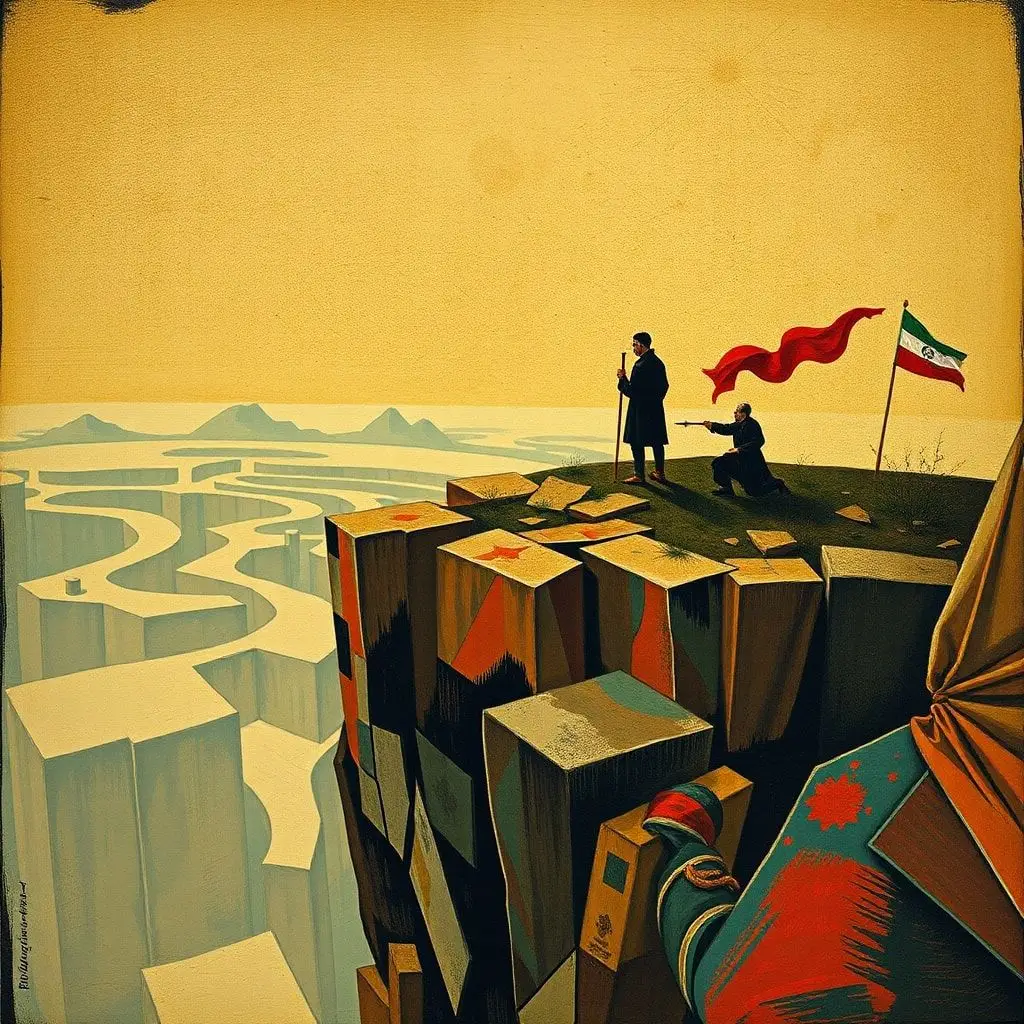
Iran on the Precipice: Navigating a Labyrinth of Tensions and Uncertainties
In the intricate tapestry of global geopolitics, few nations capture the world’s attention with the same intensity as Iran. To many observers, both within its borders and across international capitals, the Islamic Republic now finds itself hovering in a tense, precarious limbo – a state where the seemingly stable equilibrium of its internal and external dynamics could shatter, giving way to sudden and profound change. This isn’t merely a fleeting moment of apprehension; it is a deep-seated recognition of a nation at a critical juncture, buffeted by relentless external pressures, simmering internal discontent, and an increasingly assertive, yet often unpredictable, regional foreign policy. Understanding Iran’s current predicament requires an investigative journalist’s eye for detail and an analytical mind to dissect the multifaceted layers of its complex reality.
The Geopolitical Crucible: External Pressures and Regional Strife
Iran’s “tense limbo” is perhaps most acutely felt in its fraught international relations. The unilateral withdrawal of the United States from the Joint Comprehensive Plan of Action (JCPOA), commonly known as the Iran nuclear deal, and the subsequent re-imposition of crippling sanctions under the “maximum pressure” campaign, fundamentally recalibrated Iran’s strategic calculus. This move by Washington isolated Tehran further, choking its vital oil revenues and severing its ties to the global financial system. The resulting economic hardship has not only fueled internal dissent but has also hardened the resolve of Iran’s conservative leadership, often leading to more confrontational stances in regional and international forums. The shadow war with Israel continues unabated, marked by alleged Israeli strikes on Iranian assets in Syria, cyberattacks on Iranian infrastructure, and mysterious incidents targeting Iranian nuclear scientists and facilities. This undeclared conflict adds a layer of unpredictable volatility, constantly threatening to escalate into a full-blown confrontation. Moreover, Iran’s intricate dance with Saudi Arabia, a long-standing regional rival, oscillates between cautious de-escalation efforts and proxy conflicts in Yemen and elsewhere, perpetuating a cycle of suspicion and animosity across the Persian Gulf. While relations with Western powers remain largely adversarial, Tehran has concurrently strengthened its ties with Russia and China, seeking to forge an “East-oriented” foreign policy that aims to circumvent Western sanctions and establish alternative geopolitical alignments.
A Fragile Economy Under Siege: Sanctions, Inflation, and Public Hardship
At the heart of Iran’s precarious state lies its besieged economy. The severe international sanctions have inflicted profound damage, strangling its ability to export oil, which traditionally constitutes the lion’s share of its foreign exchange earnings. Access to international banking systems remains severely restricted, hindering legitimate trade and investment. The ripple effects are pervasive: hyperinflation has become a cruel reality, eroding the purchasing power of ordinary citizens and making basic necessities increasingly unaffordable. The Iranian Rial has suffered precipitous devaluations, further exacerbating import costs and economic uncertainty. Unemployment, particularly among the educated youth, remains stubbornly high, contributing to widespread frustration. State corruption, often intertwined with powerful Revolutionary Guard Corps interests, further siphons off national wealth and fuels public anger. Despite the regime’s attempts to implement a “resistance economy” aimed at self-sufficiency, the structural weaknesses, compounded by mismanagement and a lack of transparency, have left the average Iranian struggling to cope. This economic distress is not merely an abstract figure on a balance sheet; it is the lived experience of millions, shaping their daily struggles and fundamentally influencing the social and political landscape of the nation, acting as a potent catalyst for discontent and calls for systemic change. The government’s fiscal policy often appears reactive, focused on managing immediate crises rather than implementing long-term structural reforms, largely due to the pervasive impact of external pressures.
Internal Ferment: Social Unrest and the Quest for Change
The “tense limbo” is not solely a product of external pressures; it is also profoundly shaped by an escalating internal ferment. Iran has witnessed waves of significant anti-establishment protests in recent years, each fueled by a complex mix of economic grievances and demands for greater social and political freedoms. The nationwide demonstrations following the death of Mahsa Amini in 2022, sparked by the morality police’s enforcement of hijab laws, quickly evolved into a broader revolt against the ruling clerical establishment, with women and youth at the forefront. These protests highlighted deep-seated frustrations over human rights abuses, pervasive corruption, lack of personal liberties, and the systemic disconnect between the aspirations of a largely young and increasingly secularized population and the conservative doctrines of the state. While the government has responded with severe crackdowns, including arrests, detentions, and executions, the underlying causes of discontent persist. The generational divide is stark: a vibrant, tech-savvy youth population, connected to the outside world, chafes under restrictions that older generations might have tolerated. This internal struggle for change, oscillating between public defiance and suppressed dissent, creates an unpredictable dynamic where any spark could ignite further widespread unrest, challenging the very legitimacy and stability of the Islamic Republic from within. The regime’s reliance on repression as a primary tool for maintaining order only deepens the chasm between the rulers and the ruled.
The Nuclear Conundrum: A Standoff with Global Implications
Central to Iran’s current state of heightened tension is its nuclear program, a persistent source of international anxiety. Following the US withdrawal from the JCPOA, Iran systematically reduced its compliance with the agreement, dramatically increasing its uranium enrichment levels, expanding its centrifuge cascade, and restricting international inspections. The stated goal, according to Tehran, is peaceful energy production, but many global powers fear a covert pursuit of nuclear weapons capabilities. The stalemated negotiations to revive the JCPOA have only deepened this concern, pushing Iran closer to a “breakout time” – the theoretical period required to produce enough weapons-grade material for a nuclear device. This trajectory poses an existential threat to regional adversaries like Israel and Saudi Arabia and fuels proliferation fears globally. The International Atomic Energy Agency (IAEA) continues to express serious concerns about undeclared nuclear material and activities, further complicating efforts to reach a diplomatic resolution. The nuclear question is not merely a technical issue; it is a strategic flashpoint, with the potential to trigger military conflict or fundamentally reshape the regional power balance, making it a cornerstone of Iran’s precarious global standing.
Iran’s Regional Ambitions: A Network of Influence
Beyond its borders, Iran’s strategic posture is characterized by its expansive network of regional influence, often referred to as the “Axis of Resistance.” This network comprises a diverse array of state and non-state actors, including Hezbollah in Lebanon, the Assad regime in Syria, various Shia militias in Iraq, and the Houthi movement in Yemen. Through these proxies, Tehran projects its power, challenges adversaries like Israel and Saudi Arabia, and seeks to expand its ideological and strategic depth across the Middle East. These relationships provide Iran with strategic depth, allowing it to exert pressure on regional rivals without direct military confrontation, yet simultaneously drawing it into complex proxy wars with devastating humanitarian consequences. The logistical and financial support provided to these groups allows Iran to maintain a presence and exert leverage in critical geopolitical arenas, from the Mediterranean to the Arabian Sea. However, this regional assertiveness also comes at a significant cost, drawing the ire of international powers and deepening regional instability, further complicating any prospects for de-escalation or normalization of relations. The perception of Iran as a destabilizing force in the region is a direct consequence of this strategy, feeding into the wider narrative of its unpredictable trajectory.
The Path Ahead: Scenarios for a Nation at a Crossroads
Synthesizing these multifaceted pressures, Iran stands at a profound crossroads, its future shrouded in uncertainty. The “tense limbo” it inhabits is a fragile equilibrium, susceptible to disruption from myriad sources. Potential scenarios for the coming years are starkly diverse: a diplomatic breakthrough on the nuclear issue, perhaps facilitated by new international alignments, could ease sanctions and open pathways for economic relief and greater integration. Conversely, a further escalation of regional conflicts, possibly involving direct confrontation with adversaries, could plunge the entire Middle East into deeper turmoil. Internally, the ongoing struggle between an entrenched, conservative establishment and a population yearning for change suggests the possibility of continued repression leading to larger, more organized protests, or perhaps a gradual, albeit slow, evolution of political dynamics as demographic shifts take hold. The aging leadership, coupled with the question of supreme leader succession, adds another layer of unpredictability. Ultimately, Iran’s trajectory will be shaped by an intricate interplay of its internal societal pressures, the strategic decisions of its leadership, and the unpredictable forces of international geopolitics. The sudden changes that many anticipate could manifest in any of these domains, with profound implications not just for the Iranian people, but for the stability and security of the broader Middle East and beyond. The world watches, holding its breath, as Iran navigates its perilous path.