
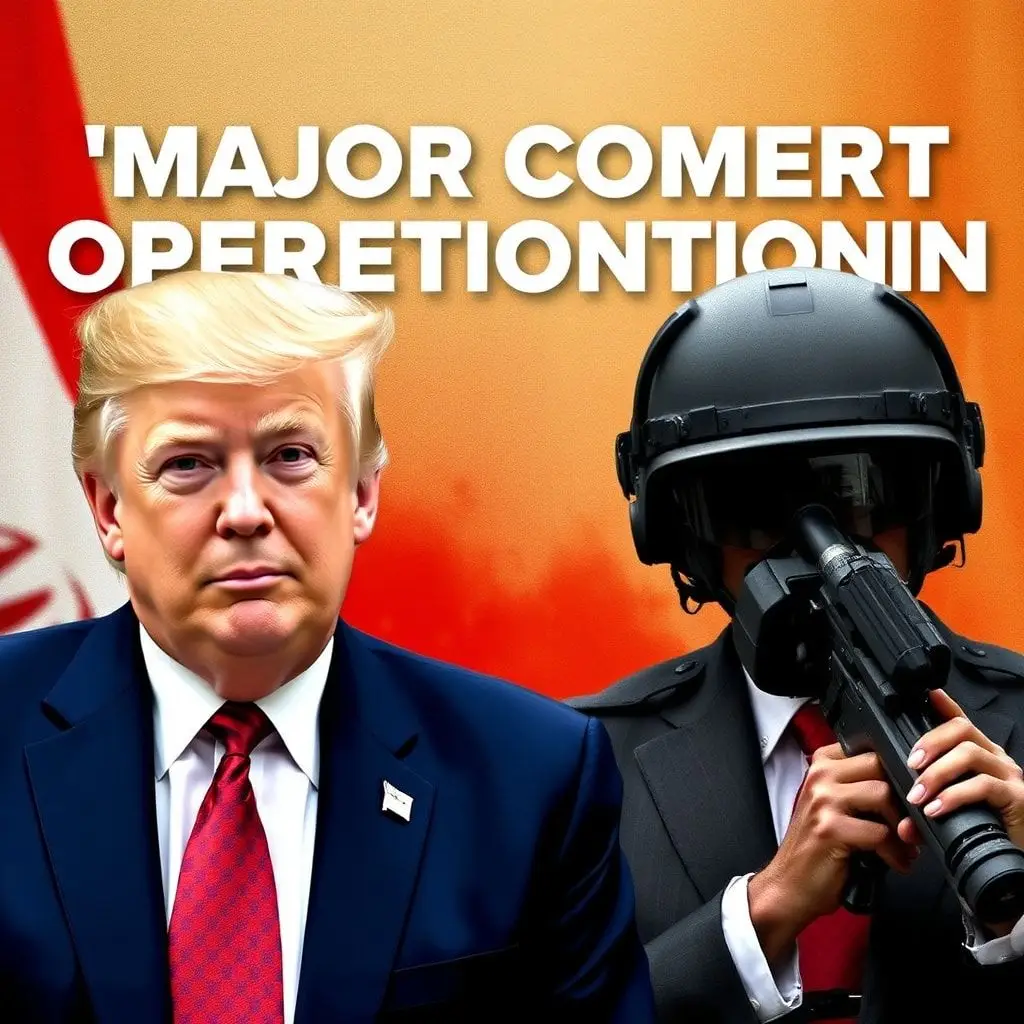
Trump Declares ‘Major Combat Operations’ in Iran: Unpacking the Geopolitical Earthquake and Its Far-Reaching Implications
In a stunning development that has sent tremors across global capitals, former President Donald Trump declared the commencement of “major combat operations” in Iran, an announcement swiftly followed by reports of widespread explosions echoing across the Islamic Republic. This declaration marks a perilous turning point in the already fraught relationship between Washington and Tehran, raising the specter of a full-scale military confrontation with potentially catastrophic consequences for regional stability and international security. The world watches with bated breath, grappling with the profound implications of such an escalation, as analysts scramble to understand the scope, objectives, and likely trajectory of these operations and Iran’s inevitable response.
Historical Context and Escalating Tensions
To truly grasp the gravity of this moment, one must delve into the labyrinthine history of US-Iran relations, a narrative punctuated by mistrust, proxy conflicts, and strategic miscalculations. Since the 1979 Islamic Revolution, which saw the overthrow of the US-backed Shah and the subsequent hostage crisis, the two nations have been locked in a cold war, occasionally threatening to erupt into open conflict. The withdrawal of the United States from the Joint Comprehensive Plan of Action (JCPOA), commonly known as the Iran nuclear deal, in 2018 under the Trump administration dramatically accelerated the descent into the current crisis. This move, coupled with a “maximum pressure” campaign involving crippling economic sanctions, led to a series of tit-for-tat escalations: attacks on oil tankers, drone shoot-downs, strikes on Saudi oil facilities, and persistent proxy skirmishes across Iraq, Syria, and Yemen. Each incident, from the assassination of Iranian General Qasem Soleimani to Iran’s measured retaliatory strikes, served to ratchet up the tension. Trump’s latest declaration is not an isolated event but the culmination of decades of antagonism, intensified by deliberate geopolitical brinkmanship, leaving little room for de-escalation once such a Rubicon has been crossed.
Defining “Major Combat Operations”: Scope and Targets
The term “major combat operations,” as articulated by Donald Trump, carries a significantly heavier weight than mere targeted strikes or punitive retaliations. It suggests a sustained, multi-faceted military engagement aimed at achieving broader strategic objectives: possibly significant degradation of military capabilities or altering Iran’s regional behavior through force. Unlike previous limited actions, this phrase implies a move beyond surgical strikes to comprehensive aerial campaigns, missile barrages, and even special forces deployments. Potential targets could range from Iran’s controversial nuclear facilities, including enrichment sites like Natanz and Fordow, to its extensive ballistic missile arsenal, Revolutionary Guard Corps (IRGC) bases, command and control centers, and naval assets in the Persian Gulf. The “explosions heard across Iran” suggest a geographically dispersed and possibly simultaneous series of attacks, indicative of a coordinated, large-scale offensive. This phase could also involve extensive cyber warfare components. The declared “major” nature of these operations signals a potentially prolonged conflict, not a “one-off” event, necessitating careful analysis of the long-term strategic goals the US might be pursuing.
Geopolitical Implications: A Region on the Brink
Regional Instability and Allied Concerns
The immediate regional fallout from such an operation would be nothing short of a seismic shift. The Middle East, already a crucible of conflicts, could plunge into an unprecedented era of instability. US allies like Saudi Arabia, Israel, and the UAE, while perhaps initially welcoming a strong stance against Iran, would simultaneously face increased risks of retaliatory attacks from Iran or its proxies. The prospect of a wider regional war, drawing in other states and non-state actors, is chillingly real. Oil prices would undoubtedly skyrocket, sending shockwaves through the global economy. Furthermore, a new wave of refugees would exacerbate existing humanitarian crises, potentially destabilizing neighboring countries like Turkey and Pakistan. The delicate balance of power, already precarious, would be irrevocably altered, leading to new alignments and heightened security concerns across the Arabian Peninsula. Ripple effects could extend to global energy supply chains and shipping lanes, particularly through the Strait of Hormuz, a critical chokepoint for a significant portion of the world’s oil trade, risking severe disruptions.
International Condemnation and Global Realignment
Internationally, the declaration of “major combat operations” would trigger a chorus of reactions. The United Nations Security Council would likely convene emergency sessions, facing immense pressure to mediate and de-escalate, though its effectiveness would hinge on the unity of its permanent members. European powers, who have consistently advocated for a diplomatic resolution and adherence to the JCPOA, would likely condemn the military action and call for restraint, fearing a broader regional conflagration and its impact on global stability. Russia and China, both with significant interests in the region, would almost certainly denounce the actions, potentially offering political or cautious military support to Iran. This could further deepen geopolitical divisions and challenge the established international order. The global community would be sharply divided, grappling with the implications of a unilateral military action by a major power, and its potential to undermine international law and institutions. The global economy, already grappling with various challenges, would face immense uncertainty, with financial markets reacting nervously to the prospect of sustained conflict.
US Domestic Ramifications
Domestically, in the United States, such a military endeavor would unleash a torrent of political debate and public scrutiny. While an initial rally-around-the-flag effect might occur, sustained engagement and potential casualties would inevitably lead to public fatigue and opposition, echoing the sentiment surrounding past protracted conflicts. The economic costs of a “major combat operation” would be immense, diverting resources from domestic priorities and potentially exacerbating national debt. The political legacy of such a decision, especially for a figure like Donald Trump, would be fiercely debated, impacting future elections and the very fabric of American foreign policy. Questions surrounding the justification, strategy, and ultimate goals of the operation would dominate headlines, putting immense pressure on leadership to demonstrate clear objectives and a viable exit strategy.
Iran’s Potential Response and Resilience
Iran, a nation with a rich history of resilience and a deeply ingrained strategic culture, would not passively absorb “major combat operations.” Its response would likely be multifaceted, asymmetrical, and designed to inflict maximum pain while avoiding a direct, conventional confrontation it cannot win. Tehran possesses a significant arsenal of ballistic and cruise missiles capable of striking US bases in the region, as well as allied targets. Its sophisticated cyber capabilities could be unleashed against critical infrastructure in the US or its allies. Furthermore, Iran’s extensive network of regional proxies – including Hezbollah, various Iraqi militias, and the Houthis in Yemen – would undoubtedly be activated to launch retaliatory attacks, creating a multi-front challenge for US forces and its partners. The Strait of Hormuz remains a critical chokepoint, and Iran has repeatedly demonstrated its capacity and willingness to disrupt shipping there. Internally, the regime would likely rally nationalist sentiment, portraying the attacks as an act of aggression against the nation, consolidating support amidst external threat. Iran’s strategy would likely focus on asymmetric warfare, leveraging its geographical advantages, naval capabilities, and regional influence to prolong the conflict, raise the costs for the aggressor, and ultimately seek a political settlement on more favorable terms.
The Elusive Path to De-escalation and Future Outlook
In the shadow of “major combat operations,” the path forward appears fraught with peril. Diplomatic avenues, already strained by years of antagonism, would be severely tested. The immediate priority for the international community would be to establish channels for de-escalation, possibly through neutral third parties like Oman, Switzerland, or the United Nations. However, the very nature of declared “major combat operations” suggests that initial efforts at diplomacy might be sidelined in favor of military objectives. Any negotiation would require a fundamental shift in posture from both sides, demanding concessions that appear increasingly unlikely amidst active hostilities. The challenge lies in finding a face-saving mechanism for both Washington and Tehran to retreat from the brink without appearing to capitulate. The long-term consequences of such a conflict, even if contained, would be profound, reshaping regional alliances, accelerating nuclear proliferation concerns, and potentially ushering in a new era of global instability. The hope, however faint, remains that even amidst the roar of conflict, opportunities for dialogue and a return to a non-military resolution can emerge, preventing a prolonged and devastating war that no party can truly win.
Conclusion
Donald Trump’s declaration of “major combat operations” in Iran, underscored by the immediate reports of explosions, represents a profound and dangerous inflection point in contemporary geopolitics. It is a moment pregnant with uncertainty, where the aspirations for regional stability and international peace hang by the thinnest of threads. The ripple effects of this escalation will undoubtedly reverberate globally, impacting economies, alliances, and the lives of millions. As the world braces for the unfolding drama, the imperative for wise leadership, strategic foresight, and an unwavering commitment to de-escalation has never been more critical. The narrative of US-Iran relations has taken a decisive, and potentially tragic, turn, the full scope of which will only become clear in the annals of history.