
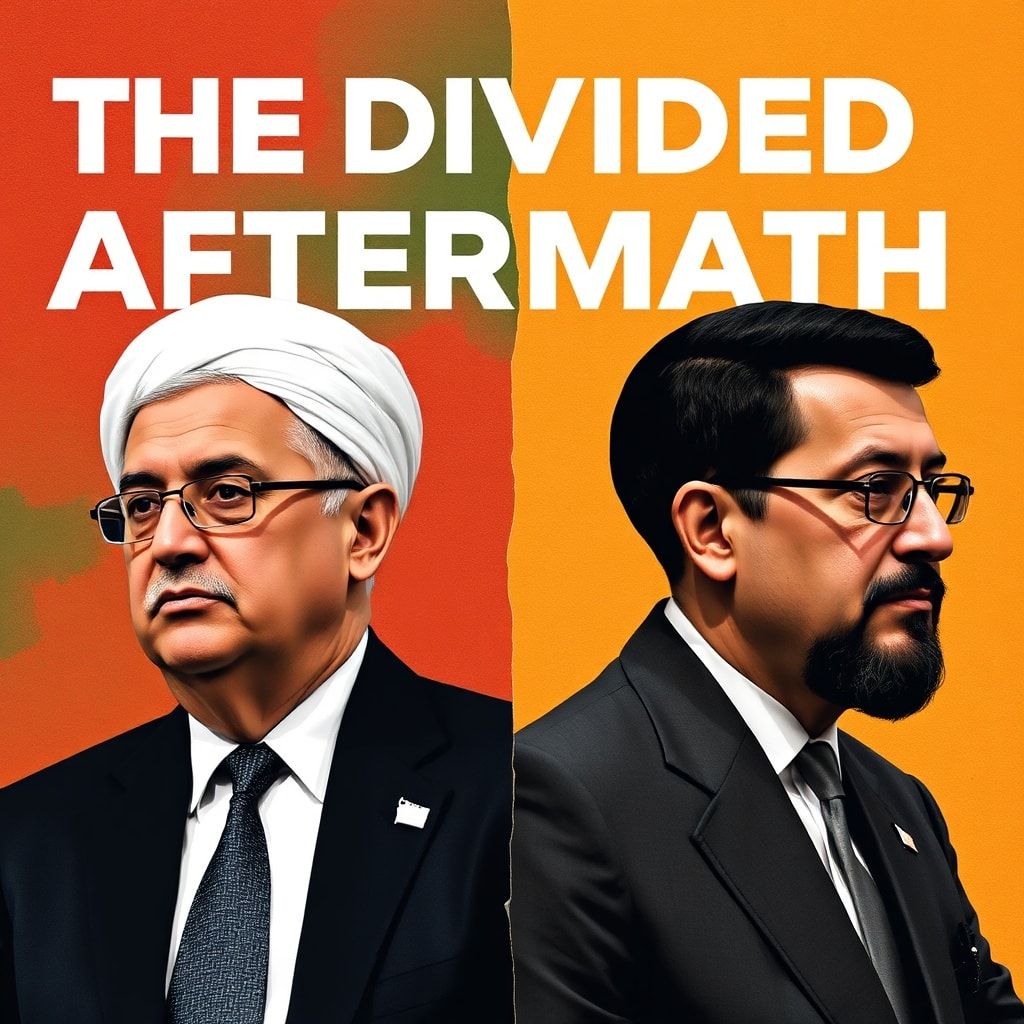
The Divided Aftermath: Global Reactions to Khamenei’s Demise and Iran’s Uncertain Future
The news of Ayatollah Ali Khamenei’s death reverberated across the globe, triggering a spectrum of profound and often conflicting emotions. While hundreds gathered in cities across the United States, their celebratory rallies painting a vivid picture of hope and liberation, the narrative within Iran and among certain international observers was far more nuanced, tinged with apprehension and complex geopolitical considerations. This pivotal moment has not only brought Khamenei’s decades-long, iron-fisted rule to a definitive close but has also cast a harsh spotlight on the deeply entrenched divisions both within Iran and among its global diaspora, signaling an era of profound uncertainty for the Islamic Republic and the wider Middle East.
Khamenei’s Legacy: A Reign Defined by Ideology and Control
Ayatollah Ali Khamenei, who assumed the role of Supreme Leader in 1989 following the death of Ayatollah Ruhollah Khomeini, presided over Iran for more than three decades, a period marked by unwavering ideological commitment, geopolitical confrontation, and significant domestic repression. His leadership solidified the Islamic Republic’s revolutionary principles, consistently challenging Western influence and projecting Iran’s power through a network of regional proxies. Domestically, Khamenei’s era saw the systematic suppression of dissent, with countless activists, journalists, and ordinary citizens facing imprisonment, torture, or execution. The moral police enforced strict social codes, while economic mismanagement and international sanctions crippled the nation’s prosperity, leading to widespread public discontent and periodic, brutal crackdowns on protests. His foreign policy was largely defined by a fierce anti-American and anti-Israeli stance, the pursuit of a controversial nuclear program, and active support for groups like Hezbollah in Lebanon, Hamas in Palestine, and various Shiite militias in Iraq and Syria. This strategic projection of power, often through asymmetric warfare and clandestine operations, deeply destabilized the Middle East, drawing Iran into proxy conflicts that cost countless lives and fostered enduring regional rivalries. His legacy is therefore viewed by many as one of profound human rights abuses, economic stagnation for the masses, and a perpetuation of a rigid, theocratic system that stifled reform and progress.
The Diaspora’s Voice: Rallies for Freedom and a New Dawn
For the Iranian diaspora, particularly those who fled the Islamic Republic’s oppressive regime or whose families experienced its brutality firsthand, Khamenei’s death was met with an outpouring of fervent celebration. From Los Angeles’ “Tehrangeles” to Washington D.C., and New York, hundreds gathered, waving pre-revolutionary flags, chanting slogans for freedom, and expressing a long-held yearning for a democratic Iran. These rallies were not merely expressions of schadenfreude but profound acts of political symbolism, representing decades of resistance against a regime they view as illegitimate and tyrannical. For many, Khamenei embodied the very essence of the system that denied basic freedoms, persecuted minorities, and silenced any voice of opposition. The celebrations underscored a deep-seated hope that his demise might pave the way for a fundamental shift in Iran’s political landscape, potentially leading to a secular, democratic future. Activists and human rights advocates among the diaspora have consistently sought to draw international attention to the plight of Iranians under the regime, and these public demonstrations served as a powerful testament to their unwavering commitment to a free Iran. The collective memory of state violence, from the 1988 mass executions to the suppression of the Green Movement in 2009 and the more recent women-led protests, fuels their desire for systemic change and accountability. Their voices, often amplified through social media and international media channels, serve as a critical external pressure point on the Iranian regime, challenging its legitimacy and narrative on the global stage.
The Dissenting Voices: Nuance, Caution, and Apprehension
However, the global reaction was far from monolithic. The RSS feed’s crucial caveat, “but not everyone was rejoicing,” points to a complex reality both inside and outside Iran. Within the country, while many undoubtedly share the diaspora’s desire for change, the immediate aftermath of a Supreme Leader’s death is a precarious period. Fear of increased instability, a brutal succession struggle, or an even more repressive successor can overshadow any initial hope. For those who benefited from or were loyal to the existing system—members of the Revolutionary Guard, Basij militia, government officials, and their families—Khamenei’s death would understandably be a cause for concern or even genuine grief. Furthermore, a significant segment of the population, even those critical of the regime, might view his death with apprehension, fearing a power vacuum that could lead to internal strife or, worse, foreign intervention. The history of the region is replete with examples where leadership changes have devolved into chaos, and for many ordinary Iranians, the stability, however oppressive, might be preferable to an unknown and potentially violent future. International analysts, too, often adopt a more cautious stance, emphasizing that the death of a single leader, even one as powerful as Khamenei, does not automatically dismantle a deeply entrenched theocratic system. They highlight the intricate web of institutions, factions, and vested interests that constitute the Islamic Republic, suggesting that fundamental change would require a much broader societal and political upheaval. The possibility of a hardline successor, potentially consolidating even greater power, is a significant concern, casting a long shadow over any nascent hopes for reform.
Geopolitical Ramifications: A Shifting Sands in the Middle East
Khamenei’s death carries immense geopolitical implications for the Middle East and beyond. His long tenure saw Iran’s influence expand significantly, often at the expense of regional rivals like Saudi Arabia and Israel. A succession crisis, or even a smooth transition to a new, potentially less experienced or more hawkish leader, could trigger significant shifts in the region’s delicate balance of power. Neighboring countries and global powers will be closely observing the selection of the next Supreme Leader, understanding that this decision will dictate Iran’s foreign policy trajectory, its approach to the nuclear deal, and its engagement with regional proxy groups. The United States, which has maintained a policy of maximum pressure on Iran, will face critical decisions regarding its diplomatic strategy. Will a new leader open avenues for renewed negotiations, or will the hardline stance intensify? For Israel and Saudi Arabia, long-standing adversaries of the Islamic Republic, the period of transition presents both potential opportunities and heightened risks. Any perceived weakening of central authority in Tehran could embolden various factions, both within Iran and among its proxies, leading to unpredictable escalations. Conversely, a strong, unified, and more aggressive successor could exacerbate existing tensions, pushing the region further to the brink. The global energy markets, heavily reliant on stability in the Persian Gulf, will also watch with bated breath, as any disruption could send oil prices soaring and trigger wider economic instability. The intricate network of alliances and rivalries in the Middle East ensures that Khamenei’s passing is not merely an internal Iranian affair but a monumental event with far-reaching international consequences.
The Path Forward for Iran: Hopes, Challenges, and Uncertainties
With Khamenei’s passing, Iran stands at a critical juncture, facing both immense challenges and the faint glimmer of potential transformation. The process of selecting a new Supreme Leader is shrouded in secrecy, involving the Assembly of Experts, an 88-member body of clerics. The choice will undoubtedly be a carefully orchestrated affair, aiming to preserve the foundational principles of the Islamic Republic while navigating internal factionalism and external pressures. The future leader will inherit a nation grappling with a crippling economy, widespread social unrest, deep distrust between the populace and the government, and significant international isolation. The aspiration for greater freedoms, social justice, and economic prosperity remains strong among the Iranian people, as evidenced by recurring protests. The question is whether the new leadership will recognize and respond to these demands, or if it will double down on the repressive policies that characterized Khamenei’s reign. Reformers within Iran, often sidelined and suppressed, may see a narrow window to push for incremental changes, but the power of the hardline establishment, particularly the Revolutionary Guard, remains formidable. The global community’s role will be crucial, with international bodies and human rights organizations continuing to advocate for greater transparency, accountability, and respect for human rights in Iran. Ultimately, the death of Khamenei, while a momentous event, marks the beginning, not the end, of a complex and potentially volatile chapter for Iran. The coming months and years will determine whether this transition leads to genuine reform and a more open society, or simply to a perpetuation of the status quo under a new, yet equally unyielding, authority. The echoes of celebration in faraway lands and the whispers of apprehension within its borders underscore the profound historical weight of this moment and the collective longing for a future free from tyranny and instability.