
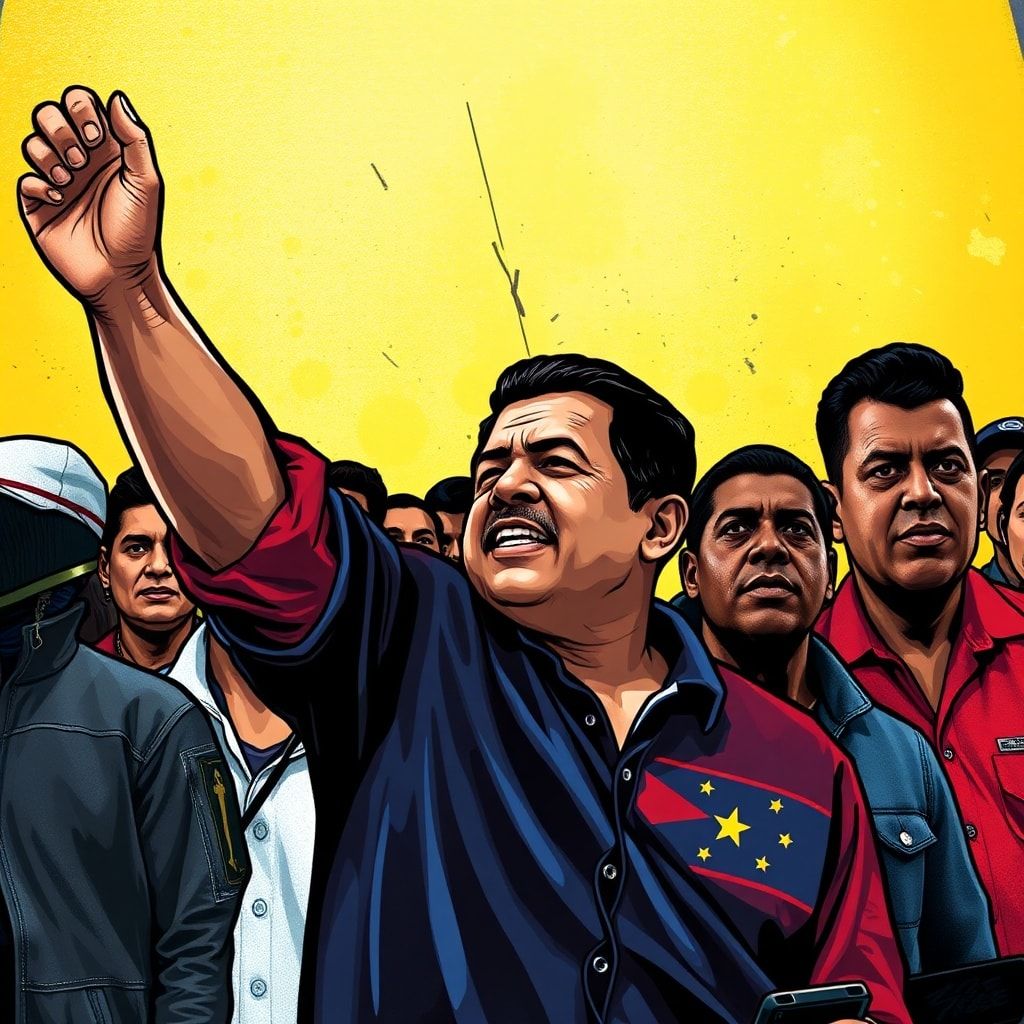
### The Maduro Seizure: A Turning Point for US Venezuela Stability?
The recent announcement from the United States regarding the seizure of Venezuelan leader Nicolas Maduro and his wife marks a dramatic escalation in the long-standing diplomatic and political standoff. This unprecedented move, followed by claims of joint efforts to promote US Venezuela stability, ignites a complex web of questions about the future of the beleaguered South American nation and its contentious relationship with the global superpower. The implications of this development are far-reaching, touching upon international law, regional geopolitics, and the dire humanitarian situation within Venezuela.
This incident immediately forces us to analyze what “joint efforts” truly mean in such a volatile environment. Who are the “two sides” making these efforts, and what kind of stability can realistically be achieved? Unpacking these questions requires a deep dive into the historical context, the immediate ramifications of the seizure, and the intricate challenges lying ahead for a nation teetering on the brink.
#### The Shifting Sands of US-Venezuelan Relations
Relations between the United States and Venezuela have been fraught with tension for decades, particularly since the rise of Hugo Chávez and the Bolivarian Revolution. Washington has consistently viewed the socialist government in Caracas with suspicion, often accusing it of undermining democracy and human rights. This adversarial stance intensified significantly under Nicolas Maduro’s presidency.
The US has levied extensive economic sanctions against Venezuela, targeting its vital oil industry and key government officials. These measures aimed to pressure Maduro’s regime, which Washington and many international bodies consider illegitimate, to cede power and allow for democratic transitions. However, critics argue that these sanctions have primarily exacerbated the humanitarian crisis, further impoverishing the Venezuelan populace.
#### The Shockwave: The Seizure of Maduro
The seizure of a sitting head of state, or an individual widely considered as such by significant international actors, is an act of immense geopolitical gravity. While the RSS content is brief, implying the act has already occurred, the exact circumstances and location of this seizure remain critical details that would shape international reaction. Such an action challenges established norms of state sovereignty and international law, potentially setting dangerous precedents.
The immediate aftermath would undoubtedly involve intense diplomatic maneuvering, urgent meetings of international bodies, and potentially heightened tensions across the region. The legal basis for such a seizure, whether related to international indictments or other claims, would be scrutinized heavily by allies and adversaries alike. This event undeniably represents a major rupture, altering the trajectory of Venezuelan politics and international relations.
#### Decoding “Joint Efforts”: A Path to US Venezuela Stability?
The US declaration of “joint efforts to promote stability” is perhaps the most intriguing and ambiguous part of the announcement. This phrase raises fundamental questions about who constitutes these “two sides” and what the nature of their cooperation would be.
One interpretation suggests these “joint efforts” might involve collaboration with elements of the Venezuelan opposition, perhaps those recognized by the US as the legitimate interim government. Their objective would be to establish a transitional authority, facilitate free and fair elections, and begin the arduous process of national reconstruction. However, the Venezuelan opposition itself is often fragmented, making truly “joint” efforts challenging.
Another possibility points to cooperation with other regional actors or international organizations. Countries like Colombia, Brazil, and members of the Lima Group have a vested interest in a stable Venezuela. The United Nations or the Organization of American States (OAS) could also play a mediating role, providing frameworks for dialogue and humanitarian aid. The success of any such initiative hinges on the willingness of various stakeholders to overcome deep-seated mistrust and prioritize the welfare of the Venezuelan people. Achieving genuine US Venezuela stability will require unprecedented levels of cooperation and compromise.
#### Venezuela’s Internal Battle for Stability
Regardless of external interventions, the core battle for stability must ultimately be fought and won within Venezuela itself. The country has been mired in an economic catastrophe, marked by hyperinflation, severe shortages of food and medicine, and a mass exodus of its citizens. The collapse of its public services and the erosion of democratic institutions have created a power vacuum and widespread discontent.
The military’s loyalty has been a critical factor in Maduro’s ability to retain power. Any significant shift in the military’s stance could dramatically alter the political landscape. Furthermore, the presence of various armed groups, both state-aligned and opposition-linked, adds another layer of complexity to the pursuit of internal peace and order. Rebuilding trust among a deeply polarized population and fostering inclusive political processes are monumental tasks that cannot be imposed solely from outside.
#### Regional and Global Repercussions for US Venezuela Stability
The implications of the Maduro seizure and subsequent efforts towards US Venezuela stability extend far beyond Venezuela’s borders. In Latin America, the event could reshape regional alliances and diplomatic postures. Some nations might see it as a legitimate intervention to restore democracy, while others could view it as an infringement on sovereignty, potentially increasing anti-US sentiment.
Globally, major powers like Russia and China, which have significant economic and strategic interests in Venezuela, would likely react strongly. Both countries have been financial and political lifelines for the Maduro regime. Their responses could range from diplomatic condemnation to more direct forms of support for remaining elements of the former government, further complicating efforts to achieve a smooth transition and US Venezuela stability. The event could also have ripple effects on global oil markets, given Venezuela’s vast reserves, though its current production capacity is severely diminished.
#### Obstacles on the Path to Genuine Stability
The path to genuine stability in Venezuela is fraught with formidable obstacles. Decades of political polarization have created profound divisions within society, making national reconciliation an uphill battle. The severe economic crisis means that any new government would inherit an enormous task of reconstruction, requiring massive international aid and strategic economic reforms.
Furthermore, the influence of various external actors, each with their own geopolitical agendas, can either facilitate or hinder efforts towards lasting peace. Ensuring that any “joint efforts” truly serve the interests of the Venezuelan people, rather than becoming a proxy battleground for international rivalries, is paramount. Transparency, accountability, and a clear roadmap for democratic transition are essential ingredients for overcoming these challenges.
#### Conclusion: A Precarious Future for US Venezuela Stability
The seizure of Nicolas Maduro and his wife represents a seismic event in the ongoing saga of Venezuela’s crisis. While the US speaks of “joint efforts to promote stability,” the reality of achieving genuine and lasting US Venezuela stability is immensely complex and precarious. This critical juncture demands careful diplomacy, a clear understanding of international law, and an unwavering focus on the humanitarian needs of the Venezuelan people.
The world watches closely as this new chapter unfolds, hopeful yet cautious about the prospects for a peaceful and democratic resolution in a nation that has suffered for too long. The coming months will reveal whether these “joint efforts” can indeed forge a new path or merely deepen the existing quagmire, impacting not just Venezuela, but the wider international order regarding US Venezuela stability.
[Internal Link: The History of Political Unrest in Venezuela]
[Internal Link: Economic Sanctions and Their Global Impact]