
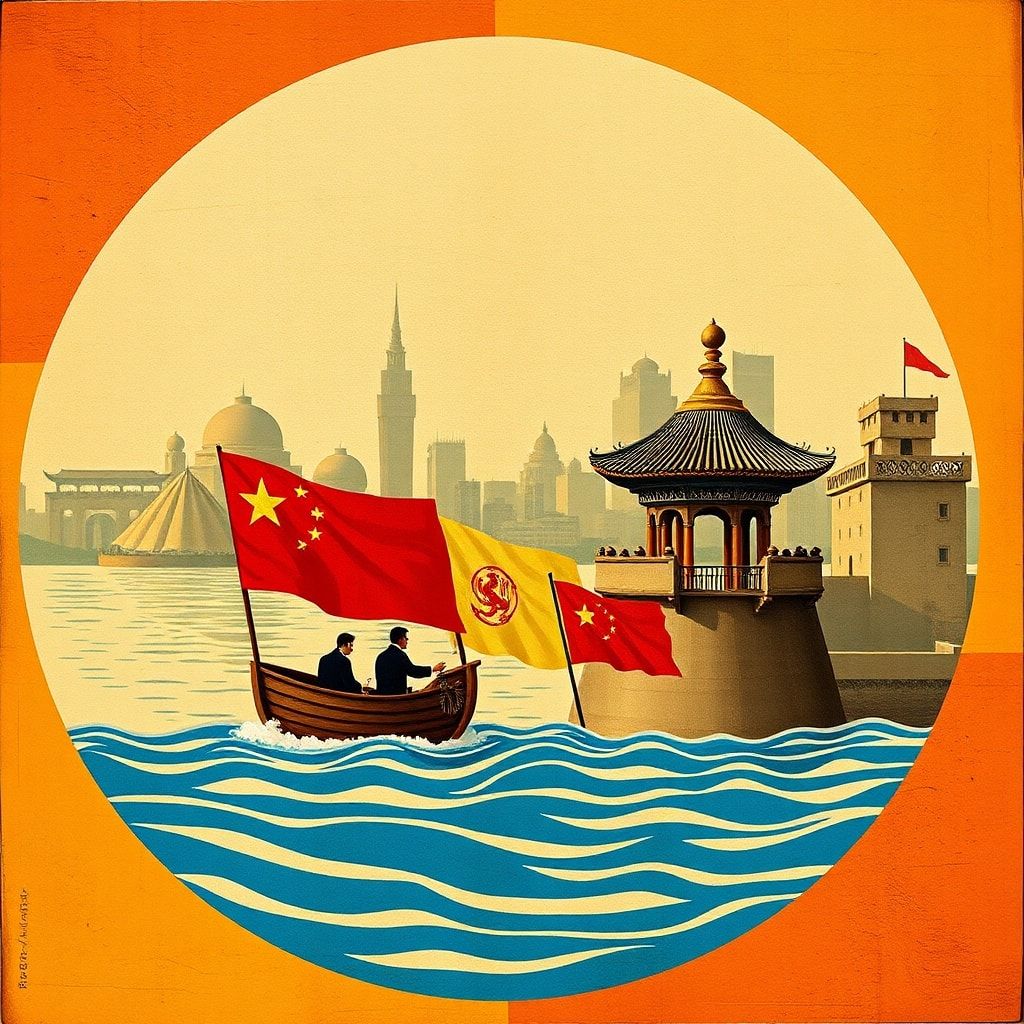
While the immediate shock of conflict in the Middle East might seem distant to Beijing, its sprawling economic and strategic interests ensure China is acutely feeling the ripples. The complex dynamics of the region, from oil flows to trade routes, have a profound and undeniable China Middle East Impact, influencing Beijing’s foreign policy and economic stability.
The Unseen Economic Tremors
China’s formidable economic engine relies heavily on global stability, particularly the smooth flow of resources from the Middle East. Rising oil prices, a direct consequence of regional unrest, act as a persistent drag on its industrial output and consumer spending, adding pressure to an already slowing economy.
Disruptions to vital shipping lanes, such as the Suez Canal or the Red Sea, also pose a significant threat. These maritime arteries are crucial for China’s vast export and import network, and any prolonged instability can lead to costly rerouting, delays, and increased insurance premiums, impacting global supply chains.
Energy Lifeline Under Threat
The Middle East remains the bedrock of China’s energy security, supplying a significant portion of its crude oil and natural gas imports. While Beijing has diversified its energy sources over the years, the sheer volume sourced from the region makes it indispensable.
Any threat to these supplies, whether from direct conflict or indirect instability, necessitates careful strategic planning. China must balance its immediate energy needs with its long-term goals of energy independence and diversification, a constant challenge amplified by regional tensions.
Beijing’s Diplomatic Balancing Act
China’s foreign policy in the Middle East has long been characterized by a principle of non-interference, focusing primarily on economic engagement. However, the escalating conflicts compel Beijing to tread a delicate diplomatic path, balancing its relationships with rival regional powers like Iran and Saudi Arabia, alongside its burgeoning ties with Israel.
This balancing act aims to protect its economic interests, ensure energy security, and avoid being drawn into intractable regional disputes. Beijing often positions itself as a neutral arbiter, advocating for de-escalation and political solutions, contrasting with the more interventionist approaches of Western powers.
A Pivot Towards Peacemaking?
In recent years, China has cautiously increased its diplomatic involvement, exemplified by its brokering of the rapprochement between Saudi Arabia and Iran. This move signaled Beijing’s desire to play a more prominent role in regional stability, albeit one focused on diplomatic rather than military solutions.
Such initiatives demonstrate a subtle shift from passive observer to active, albeit restrained, participant in Middle Eastern diplomacy. The ultimate goal remains securing its economic and strategic interests, minimizing the negative China Middle East Impact of prolonged conflict.
Belt and Road Initiative: A Fragile Network
The Middle East and North Africa region is a critical nexus for China’s ambitious Belt and Road Initiative (BRI). Numerous infrastructure projects, from ports to railways, are underway or planned, designed to enhance trade connectivity between Asia, Africa, and Europe.
Regional instability directly jeopardizes these massive investments, threatening the safety of Chinese workers and the viability of projects. Security concerns can stall construction, increase operational costs, and deter further investment, undermining the strategic goals of the BRI in a key geographical corridor.
Protecting Investments and Influence
Beyond physical infrastructure, the BRI is also a vehicle for extending China’s economic and political influence. Stable environments are paramount for the initiative’s success, allowing for predictable trade flows and secure investment returns.
When conflict flares, Beijing faces the difficult choice of either reinforcing security measures for its personnel and assets, potentially increasing its regional footprint, or scaling back operations. Both options carry significant costs and risks, highlighting the vulnerability of its grand infrastructure strategy.
Beyond Oil: Strategic Partnerships and Arms Sales
China’s engagement in the Middle East extends beyond energy and infrastructure. It has steadily increased its arms sales to various regional nations, providing military hardware and technology. This burgeoning security dimension adds another layer of complexity to its regional strategy.
These arms deals not only generate revenue but also foster deeper strategic partnerships, subtly expanding Beijing’s influence. However, it also means China is indirectly involved in the regional security matrix, further linking its fate to the stability of the Middle East.
The Evolving Security Landscape
The presence of Chinese technology and weaponry in the region complicates existing power dynamics. While China officially maintains a non-interventionist stance, its security ties underscore a growing strategic interest that goes beyond mere economic transactions.
This evolving landscape demands careful navigation from Beijing to avoid perceptions of favoritism or entanglement in proxy conflicts. The broader China Middle East Impact is felt not just in economics, but also in the delicate balance of regional military power.
Comparing Responses: China vs. The West
China’s approach to Middle Eastern conflicts starkly contrasts with that of traditional Western powers. While Western nations often prioritize security alliances, counter-terrorism efforts, and sometimes direct military intervention, China emphasizes economic development and diplomatic mediation.
Beijing’s strategy is rooted in its “non-interference” doctrine, seeking to foster stability through economic interdependence rather than through military might or regime change. This pragmatic approach allows China to maintain working relationships with a broad spectrum of actors in the region.
A Different Brand of Influence
This divergence in strategy offers Beijing unique opportunities to exert influence. By focusing on mutual economic benefit and avoiding the historical baggage of colonial or military intervention, China aims to present itself as a more benign and reliable partner.
However, this also means China’s capacity to directly resolve conflicts or enforce peace remains limited compared to powers willing to deploy significant military resources. The effectiveness of this “different brand of influence” on the overall China Middle East Impact is still being tested amidst ongoing turmoil.
The Broader China Middle East Impact on Beijing’s Strategic Calculus
The ongoing volatility in the Middle East forces China to continually re-evaluate its long-term strategic posture. Beijing must anticipate how persistent conflict, shifting alliances, and evolving global power dynamics will shape its future engagement with the region.
Its commitment to energy security and the success of the BRI ensure that the Middle East will remain a high-priority area. China’s ability to adapt its policies and maintain stability in its critical supply lines will be crucial for its continued global ascent.
The assertion that China is not feeling the “shock” of Middle East conflict holds true in the absence of direct military involvement, but the “ripples” are undeniable and far-reaching. From economic vulnerabilities and energy security concerns to the challenges faced by its ambitious Belt and Road Initiative, the China Middle East Impact is a complex web of interconnected interests. Beijing’s nuanced strategy of economic engagement and careful diplomacy aims to mitigate these ripples, yet the inherent volatility of the region ensures its future remains intricately linked to Middle Eastern stability.