
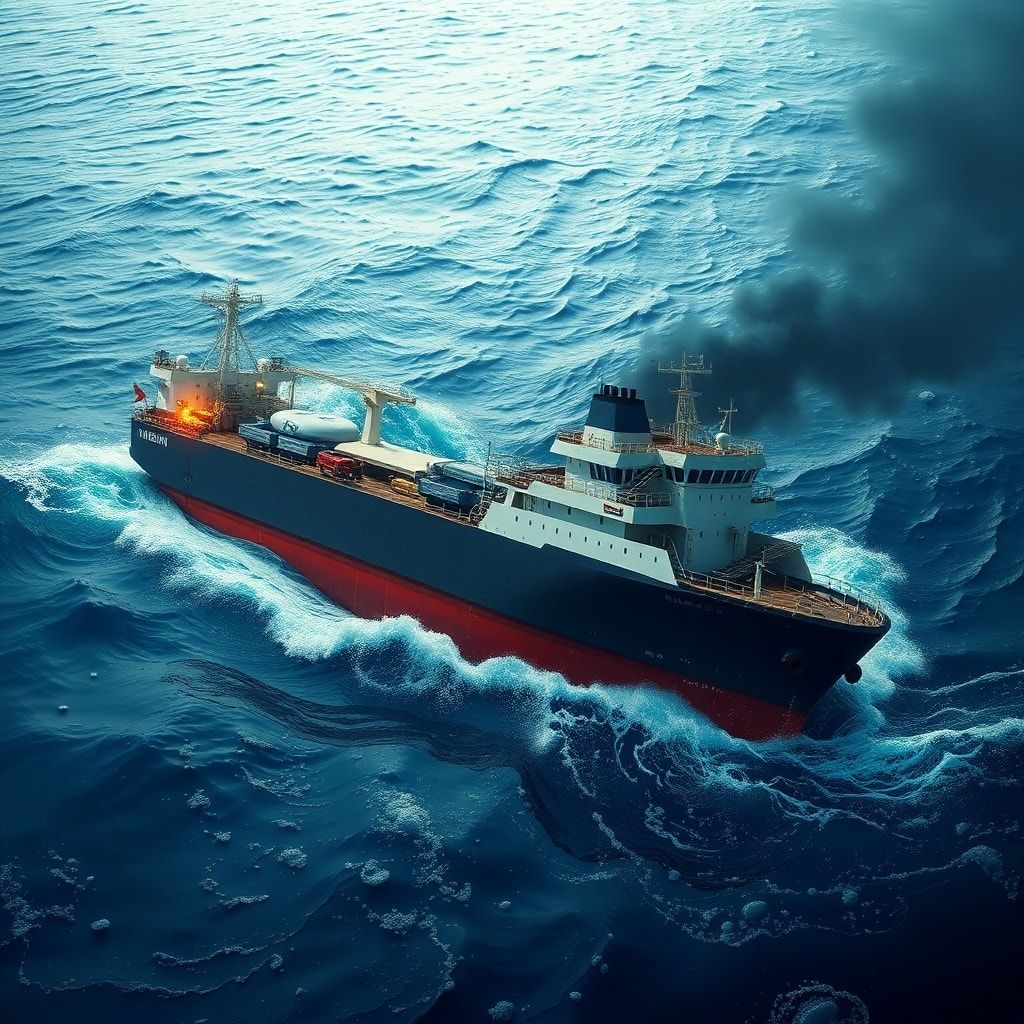
The recent incident involving the sinking of an Iranian vessel by the United States near Sri Lanka has sent ripples of concern across the Indian Ocean Region. This aggressive maneuver brings the long-standing US-Iran conflict uncomfortably close to India’s maritime doorstep, raising critical questions about regional stability and international maritime law. The implications of this Iran ship sinking India cannot be overstated, demanding a thorough examination of its geopolitical ramifications.
The Incident: A Detailed Account
Sources confirm that a US naval asset intercepted and subsequently sank an Iranian-flagged ship in international waters off the coast of Sri Lanka. The Pentagon justified the action by alleging the vessel was involved in illicit activities, including the transportation of weaponry intended for Houthi rebels in Yemen, a claim vehemently denied by Tehran.
This operation marks a significant escalation in the ongoing maritime shadow war between Washington and Tehran. While specific details about the ship’s cargo and its crew remain contested, the US move underscores its commitment to enforcing sanctions and disrupting what it perceives as destabilizing Iranian activities in the wider region.
Iran, through its state media, condemned the act as an egregious violation of international law and an act of piracy. The incident has further strained diplomatic relations, which were already at a nadir following repeated confrontations in the Persian Gulf and the Strait of Hormuz.
Geopolitical Ramifications: Iran Ship Sinking India
Escalating Tensions in the Indian Ocean
The Indian Ocean has emerged as a crucial geopolitical chessboard, vital for global trade, energy security, and strategic projection. The proximity of the Iran ship sinking India incident to the subcontinent transforms a distant conflict into an immediate regional security concern.
This area, historically traversed by merchant vessels, is increasingly militarized. The presence and assertive actions of global naval powers like the US and China, alongside regional players, create a volatile environment where miscalculation can have severe consequences.
India’s Delicate Position
India finds itself in an unenviable position, balancing complex diplomatic and strategic relationships. As a significant partner to the United States and a member of the Quad, India aligns with Washington on various security and economic fronts.
However, India also maintains long-standing historical, cultural, and economic ties with Iran. This includes investments in strategically vital projects like the Chabahar Port, which provides India with a crucial trade route to Afghanistan and Central Asia, bypassing Pakistan. The Iran ship sinking India scenario directly challenges this delicate equilibrium.
New Delhi’s strategic autonomy is tested when its allies directly engage in military action against nations with whom it shares vital interests. The incident forces India to navigate a diplomatic tightrope, preserving its alliances while safeguarding its regional interests and stability.
International Law and Sovereignty Concerns
The legality of the US action is a focal point of international debate. While the US asserts its right to interdict vessels engaged in illegal arms trafficking, the act of sinking a ship in international waters raises profound questions about sovereignty and the use of force outside declared conflict zones.
Critics argue that such unilateral actions undermine the principles of international maritime law and could set a dangerous precedent. They contend that any action should ideally be sanctioned by the UN Security Council or be in direct self-defense, neither of which appears to be the case here.
The incident also puts pressure on international bodies to clarify the legal frameworks governing interdiction and engagement in international waters, especially when dealing with non-state actors or alleged illicit activities under the guise of state-flagged vessels.
The Shadow War: Broader Context
The sinking off Sri Lanka is not an isolated event but a stark manifestation of the broader shadow war between the US and Iran. This conflict spans multiple domains, from cyber warfare and proxy conflicts in the Middle East to economic sanctions and naval posturing.
Both nations have consistently engaged in actions designed to undermine the other’s influence, often through clandestine operations or indirect confrontation. The maritime realm, particularly critical waterways, has become a primary arena for these low-intensity, high-stakes encounters.
Regional actors, including Saudi Arabia and Israel, who view Iran as a primary threat to their security, often contribute to the complex dynamics, further complicating any potential de-escalation efforts. The global energy market, heavily reliant on secure maritime passage, remains vulnerable to these escalating tensions.
Potential Repercussions and Future Outlook
Risks of Miscalculation and Escalation
The most immediate danger stemming from the Iran ship sinking India region is the heightened risk of miscalculation. In an environment devoid of direct diplomatic channels and marked by deep mistrust, such incidents can rapidly spiral out of control, leading to unintended and catastrophic consequences.
Both the US and Iran have demonstrated a willingness to respond forcefully to perceived provocations. The lack of a clear de-escalation mechanism exacerbates the potential for a direct military confrontation, which would have devastating impacts on regional and global stability.
India’s Diplomatic Tightrope Walk
India must carefully weigh its responses. While condemning any actions that threaten maritime security and freedom of navigation, New Delhi must also advocate for de-escalation. The stability of the Indian Ocean Region is paramount for India’s economic growth and national security. For more on India’s strategic maritime interests, see [Internal Link 1].
Any prolonged instability in the waters surrounding Sri Lanka directly impacts India’s trade routes, energy imports, and overall economic prosperity. India will likely engage in behind-the-scenes diplomacy, urging restraint from all parties and emphasizing the need for adherence to international law. The broader impact of sanctions on Iran, for instance, has long been a factor for Indian foreign policy, see [Internal Link 2].
Conclusion
The sinking of an Iranian vessel by the US near Sri Lanka is a significant and worrying development. It not only intensifies the long-running US-Iran rivalry but also brings this dangerous conflict to the doorstep of a crucial and increasingly strategic region. The implications of this Iran ship sinking India scenario extend far beyond the immediate incident, threatening to destabilize an already fragile geopolitical landscape.
As an investigative journalist, it is clear that the international community must closely monitor these developments and push for diplomatic solutions. The stakes are too high to allow for further escalation in one of the world’s most vital maritime corridors.