
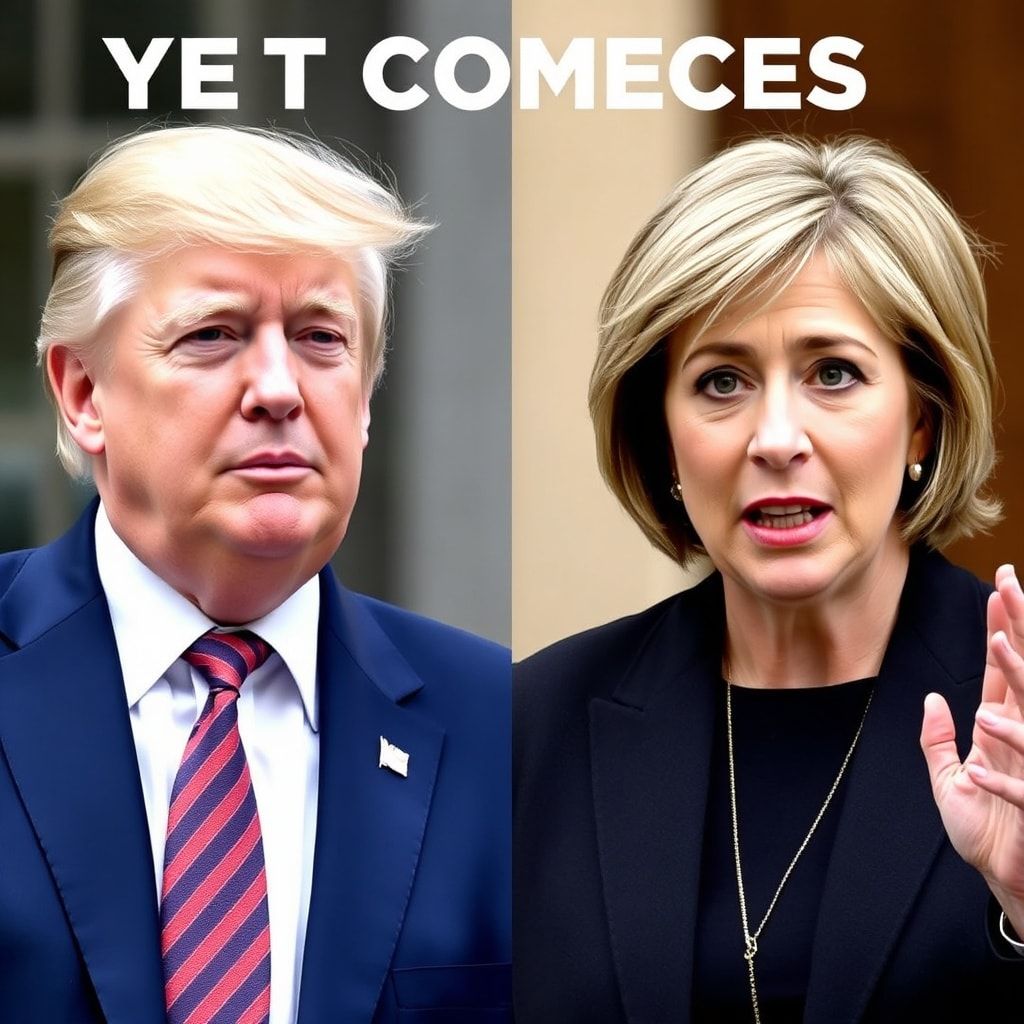
The diplomatic landscape between the United Kingdom and the United States has once again been rattled, this time by a direct confrontation over the **UK Iran response**. Foreign Secretary Yvette Cooper has firmly pushed back against President Trump’s pointed criticisms regarding London’s handling of the escalating tensions with Tehran. This high-stakes exchange not only highlights a transatlantic rift but also underscores differing strategic approaches to one of the world’s most volatile regions.
President Trump’s administration has consistently advocated for a more aggressive stance against Iran, frequently expressing dissatisfaction with what he perceives as a lack of robust support from European allies. His public rebuke of the UK’s approach signals a deeper divergence in foreign policy philosophies, challenging the traditional solidarity of the special relationship.
The backdrop to this diplomatic spat is a period of heightened regional instability, marked by attacks on oil facilities, shipping, and a general increase in rhetoric. The global community watches closely as major powers navigate these treacherous waters, seeking to prevent a full-scale conflict while protecting their varied interests.
## Analyzing the UK Iran Response and Trump’s Critique
President Trump’s criticism emerged from a broader pattern of his administration’s “America First” foreign policy, often characterized by a willingness to challenge long-standing alliances. His public comments suggested the UK’s actions, or inactions, were insufficient in deterring Iranian aggression or supporting US initiatives. This critique placed significant pressure on London to justify its considered and often more measured diplomatic strategy.
The core of Trump’s argument often revolved around the premise that European nations, including the UK, were not doing enough to support US efforts to isolate and pressure Iran. He has repeatedly called for allies to abandon the Joint Comprehensive Plan of Action (JCPOA), or Iran nuclear deal, which the US unilaterally withdrew from in 2018. The UK, alongside France and Germany, has maintained its commitment to the deal, viewing it as a crucial mechanism for preventing nuclear proliferation, despite its imperfections. This fundamental disagreement forms a significant part of the differing approaches.
### The Immediate Aftermath: Escalation and Diplomacy
Following a series of provocations in the Persian Gulf, the international community braced for further escalation. The UK, in conjunction with its European partners, has consistently called for de-escalation through diplomatic channels. This approach prioritizes dialogue and multilateral engagement over unilateral military threats, starkly contrasting with Trump’s often confrontational rhetoric.
Yvette Cooper’s defense emphasized the complexity of the situation and the UK’s commitment to international law and collective security. She underscored the importance of a coordinated international effort, not just reactive measures, to address the underlying causes of instability in the region. The UK’s strategy aims to de-escalate without capitulating to aggression, a delicate balance that often draws criticism from those advocating for immediate, forceful responses.
### Trump’s Stance: A History of Criticism
President Trump’s skepticism towards multilateral agreements and traditional alliances is well-documented. His administration has frequently questioned the value of organizations like NATO and challenged the foreign policy directions of allies on various fronts. His criticism of the UK’s approach fits into this broader pattern, signaling a desire for allies to align more closely with US unilateral policy decisions.
This historical context is crucial for understanding the current diplomatic friction. Trump’s administration views its hardline stance against Iran as essential for regional stability and global security, often expressing frustration with allies who do not share this intensity or approach. The expectation for absolute alignment has been a recurring theme in his dealings with European partners.
## The UK’s Diplomatic Tightrope Walk
The UK finds itself in a precarious position, balancing its long-standing alliance with the United States against its own national interests, diplomatic principles, and commitments to European partners. The specific details of the **UK Iran response** reflect this complex balancing act, attempting to de-escalate tensions while maintaining pressure on Iran to comply with international norms.
London’s strategy has often involved supporting diplomatic initiatives to preserve the remnants of the Iran nuclear deal while simultaneously condemning Iranian actions that destabilize the region. This dual approach aims to keep channels of communication open while signaling resolve against unacceptable behavior, a more nuanced position than the outright rejection favored by the Trump administration.
### Balancing Allies and National Interest
For the UK, navigating the Iran crisis involves more than just reacting to immediate threats. It requires a careful consideration of its geopolitical standing, economic interests, and commitment to international stability. Abandoning its European allies to align entirely with the US could damage vital relationships and undermine its influence on the global stage.
Furthermore, the UK has its own significant economic ties and security interests in the Middle East that necessitate a sophisticated, independent foreign policy. Cooper’s statements reflect a determination to protect these interests while contributing to broader international peace and security, rather than simply adopting Washington’s playbook. This independent stance is critical for its sovereign foreign policy.
### Historical Context of UK-Iran Relations
The relationship between the UK and Iran has a complex and often fraught history, marked by periods of cooperation and profound tension. From colonial influence to oil nationalization and more recent diplomatic challenges, this deep-seated history informs the UK’s current cautious approach. Understanding this historical baggage is vital for grasping the nuances of its approach.
Past interventions and diplomatic failures serve as a reminder of the need for measured and thoughtful engagement. The UK understands that impulsive actions can have long-lasting, detrimental consequences, a lesson that underpins its current diplomatic efforts. This historical perspective often contrasts with the more immediate and often short-term perspectives that have sometimes characterized the Trump administration’s foreign policy.
## Global Ramifications and Future Prospects
The public disagreement over the UK’s approach carries significant implications for the future of transatlantic relations and the broader international order. It highlights a growing divergence in strategic outlooks between traditional allies, potentially weakening a united front against global challenges. The challenge lies in reconciling these differences while ensuring regional stability.
The spat also underscores the fragility of international consensus on critical foreign policy issues. If key allies cannot agree on a fundamental approach to major geopolitical flashpoints, the effectiveness of international diplomacy and collective security mechanisms could be severely hampered. The ongoing tensions with Iran serve as a litmus test for the resilience of these alliances.
### European Solidarity vs. US Unilateralism
The UK’s position often aligns more closely with that of its European counterparts, who have largely maintained a commitment to the JCPOA and advocated for a diplomatic path with Iran. This European solidarity represents a counterweight to the US’s unilateral approach, emphasizing multilateralism and adherence to international agreements.
Yvette Cooper’s defense of the UK’s strategy can be seen as an articulation of this broader European perspective. It’s a call for patience, strategic foresight, and collective action, rather than immediate confrontation. This difference in philosophy shapes the UK’s overall approach and its reception globally.
### The Path Forward: De-escalation Strategies
The immediate priority for the UK and its European allies remains de-escalation in the Persian Gulf. This involves a sustained effort to open channels of communication, reduce military tensions, and explore diplomatic solutions that can address both Iran’s nuclear program and its regional activities. The goal is to prevent miscalculation and accidental escalation.
For the transatlantic alliance, the challenge will be to bridge the gap between Washington’s assertive posture and Europe’s more cautious diplomacy. Finding common ground on the **UK Iran response** will require significant diplomatic effort, mutual understanding, and a willingness to compromise on both sides to avoid further damaging an already strained relationship.
In conclusion, Foreign Secretary Yvette Cooper’s firm rebuttal of President Trump’s criticism regarding the **UK Iran response** illuminates a critical juncture in international relations. It underscores the divergent paths taken by key allies in confronting complex geopolitical challenges. The UK’s commitment to a balanced, diplomatic approach, rooted in its own strategic interests and historical understanding, continues to define its foreign policy amidst a turbulent global landscape. The implications of this rift will undoubtedly shape future engagements with Iran and the very fabric of transatlantic cooperation.