
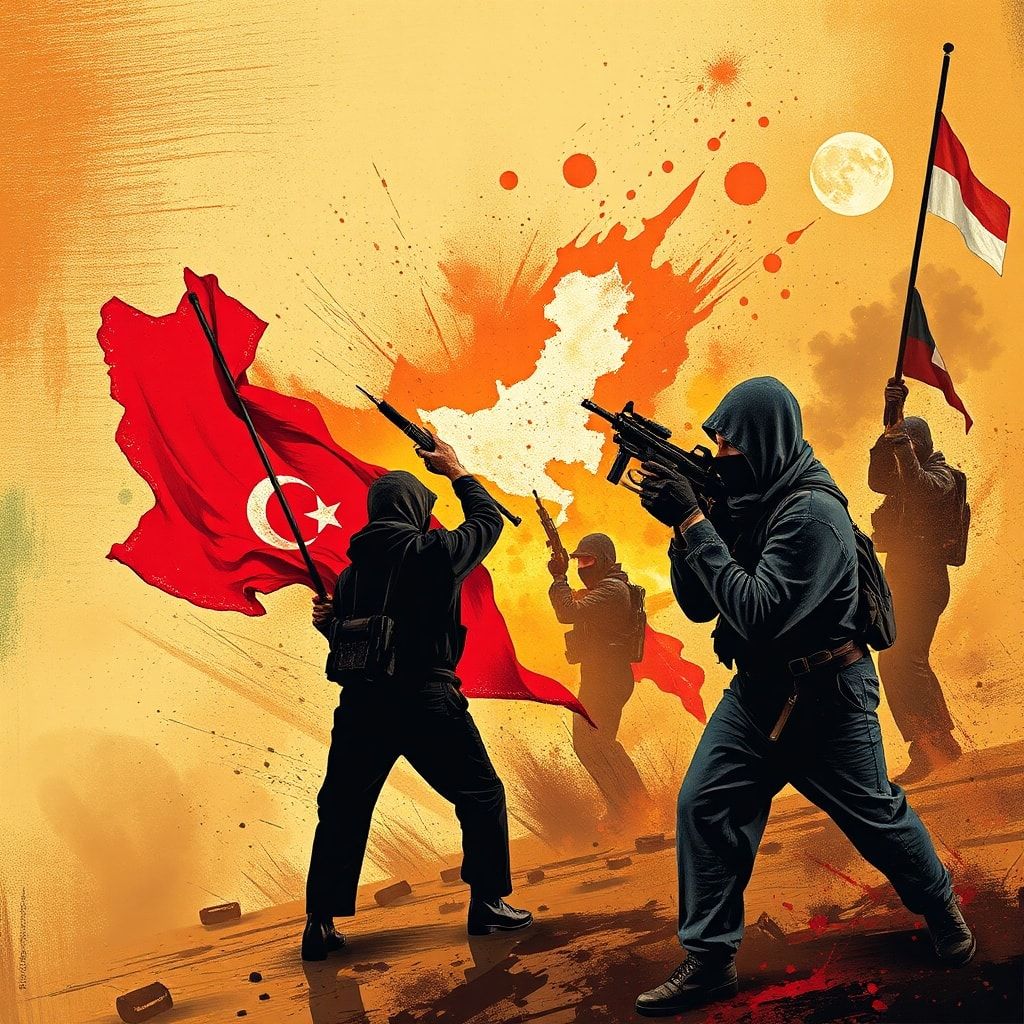
Title: Iran Kurdish Conflict: Unpacking Escalation & US Speculation
Introduction
Recent reports confirm a significant escalation in the Iran Kurdish Conflict, marked by swift and decisive Iranian military strikes. These actions have ignited considerable speculation that the United States is seeking to enlist Iranian Kurdish groups in its ongoing, multifaceted rivalry with Tehran. This potential development raises critical questions about regional stability, the complex web of proxy warfare, and the future of international relations in the Middle East, demanding a thorough analytical examination.
Understanding the Iran Kurdish Conflict
A History of Tensions
Iran has a long and complex history with its Kurdish minority, a significant ethnic group often feeling marginalized by the central government. For decades, various Iranian Kurdish opposition groups, many of which have established bases across the border in Iraq’s semi-autonomous Kurdistan Region, have sought greater autonomy or even outright independence. Tehran views these groups as direct threats to its national security, accusing them of separatism and engaging in destabilizing activities.
These groups often engage in cross-border incursions, sometimes clashing with Iranian Revolutionary Guard Corps (IRGC) forces. They also undertake political agitation aimed at galvanizing support among Iranian Kurds. Iran consistently frames these activities as foreign-backed terrorism, justifying its military responses. The recent strikes are therefore not isolated incidents but part of a long-standing, often violent, confrontation along the porous border.
Key Kurdish Opposition Groups
Several prominent Iranian Kurdish opposition parties operate from Iraqi Kurdistan, leveraging the relative security and autonomy of the region. Groups such as the Kurdistan Democratic Party of Iran (KDPI), Komala (the Communist Party of Iran – Kurdistan Organization), and the Kurdistan Freedom Party (PAK) have maintained a presence there for years. These groups operate with varying degrees of political organization and military capability.
Their stated goals diverge, ranging from advocating for increased cultural and political rights for Kurds within a democratic, federal Iran to outright secession and the creation of an independent Kurdish state. Their sustained presence in a neighboring country, largely beyond direct Iranian government control, has always been a profound point of contention and a continuous source of tension between Iran and Iraq. This geopolitical arrangement fuels the perpetual Iran Kurdish Conflict.
The US Dimension: Speculation and Strategy
Why US Involvement?
The notion that the United States might actively leverage Iranian Kurdish groups against Tehran is not without historical precedent or strategic rationale. Washington has a long and often controversial history of supporting various opposition movements globally to achieve its foreign policy objectives. In the context of its strategic competition with Iran, any group capable of applying internal pressure on the Iranian regime could be considered a valuable asset.
Such a strategy could aim to destabilize the Iranian regime internally, diverting its military and economic resources away from regional proxy activities. It could also be seen as a clandestine way to create significant leverage in broader international negotiations concerning Iran’s nuclear program or its regional influence. Furthermore, it might be perceived as a cost-effective method to counter Iranian aggression without requiring direct, large-scale US military intervention. The current intensity of the Iran Kurdish Conflict presents a ready-made opportunity for such an approach.
Risks of Alliance
However, the potential for overt or covert US support to Iranian Kurdish groups carries immense and multifaceted risks. Such a move could provoke a far more aggressive and widespread response from Tehran, potentially leading to a significant escalation of regional instability. Any perceived US involvement would undoubtedly be framed by the Iranian government as an egregious act of direct interference and an unambiguous declaration of aggression, rallying nationalist support against Washington.
Moreover, this strategy could inadvertently entangle the US in a highly complex and deeply entrenched ethno-nationalist conflict with inherently unpredictable outcomes. The diverse nature, differing political agendas, and often conflicting objectives of the various Kurdish groups themselves mean that forming and maintaining a cohesive or effective alliance could prove exceedingly difficult. It would also severely complicate Iraq’s already delicate internal political balance, straining its sovereignty and potentially fueling further internal strife within the Kurdistan Region itself.
Regional Ripples and Geopolitical Chessboard
Iraq’s Precarious Position
Iraq, particularly the semi-autonomous Kurdistan Regional Government (KRG) in Erbil, finds itself in an incredibly difficult and unenviable geopolitical position. Hosting Iranian Kurdish opposition groups while simultaneously striving to maintain stable and functional relations with its powerful neighbor, Iran, is a perpetual and hazardous balancing act. The frequent Iranian military strikes, which often occur on Iraqi soil, represent clear violations of its national sovereignty, generating significant diplomatic strain and internal political pressure.
This situation places immense pressure on both the central government in Baghdad and the KRG in Erbil to either control or expel the activities of these groups. Any overt US-Kurdish alignment could further destabilize Iraqi security, create deeper ethnic and political divisions within the country, and potentially lead to broader internal strife, complicating the already fragile post-conflict reconstruction efforts.
Broader Middle East Implications
The Iran Kurdish Conflict is far from an isolated event; it is deeply intertwined with the broader geopolitical chessboard of the Middle East, where numerous regional and international actors have vested interests. Turkey, for instance, has its own significant Kurdish population and has long conducted extensive military operations against Kurdish groups, particularly the Kurdistan Workers’ Party (PKK), in northern Iraq and Syria. An escalation involving Iranian Kurds could easily draw in other regional players, each with their own complex historical grievances, strategic objectives, and shifting alliances.
Saudi Arabia and Israel, both prominent regional powers intensely wary of Iran’s burgeoning influence and its nuclear ambitions, might view such developments through a highly opportunistic lens. They could potentially encourage or even clandestinely support further regional realignment aimed at weakening Tehran, thereby increasing the volatility of the entire region. This intricate and interconnected web of relationships makes any external involvement, particularly from a global superpower like the US, incredibly fraught with danger and unpredictable consequences.
The Path Ahead: Risks of Escalation
A Dangerous Precedent
If the persistent speculation about US intentions proves to be accurate, it would undoubtedly set a dangerous and potentially catastrophic precedent for international relations. Actively supporting proxy groups against a sovereign nation, even one with whom the US has profound and long-standing disagreements, risks an unprecedented escalation of an already tense and volatile situation. It could transform the localized Iran Kurdish Conflict into a more widespread and intractable proxy war, engulfing multiple nations and drawing in various non-state actors.
Furthermore, such an approach could ironically backfire, strengthening hardliners within the Iranian regime and unifying nationalist sentiment against perceived foreign interference. The historical record of similar interventions globally suggests that they often lead to prolonged conflict, humanitarian crises, and unintended consequences rather than swift or decisive resolutions. The complexities demand restraint and a focus on diplomatic rather than confrontational solutions.
Conclusion
The recent Iranian military strikes, coupled with the persistent speculation regarding US intentions to engage Iranian Kurdish groups, underscore the inherently volatile and precarious nature of the Middle East. The Iran Kurdish Conflict is a deeply rooted and multifaceted issue, intricately complicated by historical grievances, ethnic tensions, and intense regional power struggles. Any external intervention, particularly from a global superpower, risks igniting a broader and uncontrollable conflagration that could destabilize the entire region. The path forward demands an exceptional degree of careful diplomatic navigation, a profound respect for national sovereignty, and a steadfast commitment to de-escalation. These are crucial steps to prevent an already fragile region from spiraling into further chaos. The world watches keenly as this complex geopolitical drama continues to unfold, holding its breath for what comes next.