
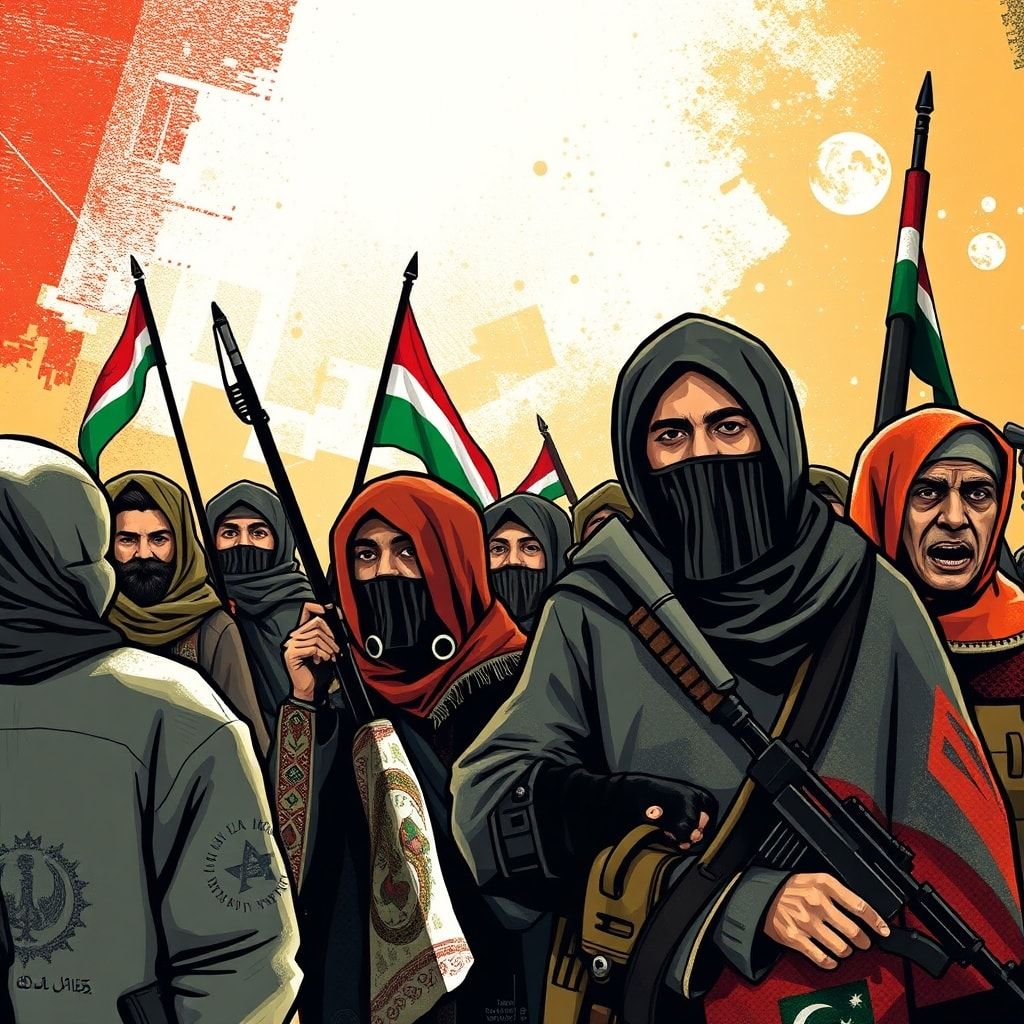
Introduction
The recent surge in Iranian military operations, specifically targeting alleged militant bases within Iraqi Kurdistan, has reignited long-standing tensions in the Middle East. These calculated strikes occur amid a simmering geopolitical backdrop, fueled by growing speculation that the United States might be subtly encouraging various Iran Kurdish groups to intensify their opposition against the Iranian regime. This unfolding scenario is more than just a localized conflict; it represents a critical juncture that could redefine regional power dynamics, influence international relations, and significantly impact the aspirations of Kurdish communities across borders. A thorough examination requires dissecting historical grievances, analyzing strategic motivations of all parties, and contemplating the potentially far-reaching consequences of such an intricate interplay.
H2: Escalating Tensions: Iran’s Military Actions Intensify
In a series of decisive and often controversial moves, Iran’s Islamic Revolutionary Guard Corps (IRGC) has launched multiple waves of drone and missile attacks deep into Iraqi Kurdistan. These highly publicized operations have specifically targeted what Tehran asserts are the operational bases and logistical centers of Iranian-Kurdish opposition factions. These factions, according to Iran, are actively involved in separatist movements and cross-border insurgency.
Tehran’s justification for these aggressive actions is consistently framed within the context of national security. Iranian officials claim these groups are receiving clandestine support and weaponry from external adversaries, posing an immediate and existential threat to the integrity and stability of the Islamic Republic. This narrative serves to legitimize military interventions that frequently disregard international boundaries, further complicating already strained diplomatic relations with Baghdad and international bodies. The scale and frequency of these recent attacks suggest a calculated effort to project power and deter any perceived internal or external challenges emanating from its western frontier.
H3: A Legacy of Conflict: Historical Context of Iranian-Kurdish Relations
The relationship between the Iranian central government and its substantial Kurdish minority has been characterized by centuries of mistrust, sporadic uprisings, and often brutal state repression. Kurds, a distinct ethnic group predominantly residing in a contiguous mountainous region often referred to as Kurdistan, are spread across the borders of Iran, Iraq, Syria, and Turkey. In Iran, the Kurdish population, numbering several million, has consistently struggled for greater cultural, political, and economic rights. They often face systemic discrimination and marginalization.
Numerous political and armed Iran Kurdish groups, advocating for greater autonomy or outright independence, have historically operated from exile, finding refuge and establishing bases primarily within the relatively autonomous Kurdistan Region of Iraq (KRI). Organizations such as the Democratic Party of Iranian Kurdistan (PDKI) and Komala have waged intermittent armed struggles against Tehran for decades. Their continued presence and occasional cross-border activities have remained a persistent and deeply sensitive point of contention for successive Iranian governments, who view them as existential threats orchestrated by foreign powers.
H2: The US Factor: Unpacking Speculation and Geopolitical Strategy
The pervasive speculation regarding potential US encouragement for Iran Kurdish groups to engage in broader conflict with Tehran is rooted in a complex history of American foreign policy in the Middle East. The United States has, at various times, provided support to anti-regime or opposition elements in the region, particularly when perceived as serving broader strategic interests. The idea of leveraging internal dissent as a tool to pressure or destabilize the Iranian regime is a concept that has been discussed in some policy circles for decades.
However, moving from speculative discussions to overt military backing for these groups, explicitly to fuel a proxy war with Iran, would represent an extremely significant and high-stakes escalation. Such a move would undoubtedly carry immense and unpredictable risks for an already fragile regional stability. It could easily draw the United States into a direct, large-scale conflict, a scenario both Washington and Tehran have generally sought to avoid. The geopolitical chessboard is intricate, and every move carries potential for severe, unintended consequences.
The US maintains a considerable military and diplomatic presence in Iraq. Its enduring relationship with the Iraqi Kurdistan Regional Government (KRG), a crucial ally in the fight against ISIS, is also a well-documented factor. This sustained presence and influence in the region often serve as a backdrop, naturally fueling various speculations about American intentions and covert operations involving local actors. The question remains whether Washington would risk such a direct challenge to Iranian sovereignty through proxy forces.
H3: Navigating US Objectives: Between Containment and Direct Conflict
Analysts are deeply divided on the true extent and nature of current US objectives in the Middle East, particularly concerning Iran. While the overarching American foreign policy goal has been to contain Iranian influence and prevent its acquisition of nuclear weapons, the approach to achieving this goal is subject to intense debate. Encouraging such groups to escalate activities could, from a certain strategic vantage point, be perceived as a relatively low-cost, high-impact method of pressuring Tehran without direct military engagement. This strategy could aim to divert Iranian resources, create internal instability, and perhaps even force a change in regime behavior.
Conversely, many experts argue that such a strategy would be extraordinarily reckless and counterproductive. Direct or indirect support for these groups could severely alienate the Iraqi central government in Baghdad, which has its own complex relationship with both Washington and Tehran. It could also drastically destabilize the already delicate political balance within the semi-autonomous Kurdistan region itself, potentially igniting wider ethnic and sectarian conflicts. Washington’s historical foreign policy in the Middle East has frequently been criticized for its inability to consistently balance competing interests and predict long-term consequences.
Any overt or covert perceived US support for these specific groups would almost certainly undermine existing diplomatic channels and efforts to de-escalate tensions with Iran. It would likely provoke an even stronger, more unpredictable, and potentially retaliatory response from Tehran, which has demonstrated a willingness to project power both regionally and internationally. The implications of such a strategy extend far beyond the immediate border regions, impacting global energy markets, international shipping lanes, and broader alliance structures.
H2: Regional Repercussions: The Precarious Future of Iran Kurdish Groups
The current escalation of Iranian strikes, coupled with the speculative role of the US, sends significant shockwaves across the entire Middle East. Iraq’s national sovereignty is repeatedly undermined by these cross-border military operations, placing immense diplomatic and political pressure on Baghdad. The Iraqi central government finds itself in an unenviable position, attempting to balance its fragile relationship with Tehran, a powerful neighbor, and its strategic partnership with Washington, its primary security guarantor. The continued violation of its airspace and territory creates a dangerous precedent and further erodes its authority.
Neighboring Turkey, a powerful regional actor with its own long-standing and often violent conflict with Kurdish separatist groups (particularly the PKK), watches these developments with intense scrutiny. Ankara frequently conducts its own military campaigns against Kurdish factions in northern Iraq and Syria, viewing them as direct threats to its national security. Any perceived shift in the regional balance of power, or any new alignment of forces involving Iran Kurdish groups, could trigger fresh military interventions or diplomatic realignments from Turkey, further complicating the already intricate geopolitical tapestry.
For the various Iran Kurdish groups themselves, the current situation is exceptionally precarious. They are trapped between the unwavering hostility of the Iranian state, which views them as terrorists and secessionists, and the unpredictable, often opportunistic, geopolitics of the wider region. Their long-held aspirations for greater rights, self-determination, or an independent state are frequently manipulated by larger powers, transforming them into pawns in proxy conflicts. Their survival and future prospects rely heavily on a highly fluid and dangerous external dynamic, making their path forward incredibly uncertain and perilous.
H3: The Unseen Cost: Humanitarian Concerns and Civilian Impact
Amidst the high-stakes geopolitical maneuvering and military posturing, the most tragic and often overlooked consequence is the severe humanitarian cost borne by innocent civilians. Residents in the border regions of Iraqi Kurdistan, many of whom are already displaced from previous conflicts, are frequently caught in the crossfire. Villages are evacuated, homes are destroyed, and essential infrastructure, including schools and hospitals, suffers damage. The continuous cycle of violence forces families to abandon their livelihoods and seek refuge, exacerbating existing humanitarian crises.
International humanitarian organizations, along with the United Nations, consistently issue urgent calls for de-escalation, adherence to international law, and, crucially, the protection of non-combatants. However, in the complex and often brutal reality of regional conflicts driven by state interests and proxy agendas, these appeals frequently go unheeded. The plight of displaced communities, the psychological trauma inflicted upon children, and the long-term societal damage caused by persistent conflict remain critical and often unaddressed concerns that demand greater international attention and sustained efforts towards peaceful resolution.
Conclusion
The recent volley of Iranian military strikes, inextricably linked with the swirling speculation about US encouragement for Iran Kurdish groups, vividly illustrates the profound and deeply entrenched instability plaguing the Middle East. This volatile situation is not merely a contemporary flashpoint; it is a direct result of a complex interplay of centuries-old ethnic and national grievances, deeply rooted geopolitical rivalries, and the often-unpredictable dynamics of international power politics. While Tehran vociferously defends its actions as vital for national security, the inherent risk of a wider regional conflict looms dangerously large. The future trajectory for Iran Kurdish groups and the broader pursuit of peace in the region hinge precariously on a delicate and meticulously choreographed dance of diplomacy, strategic communication, and, above all, restraint. Any miscalculation, whether intentional or accidental, carries the potential for catastrophic consequences for all involved parties, further entrenching a cycle of violence and instability.