
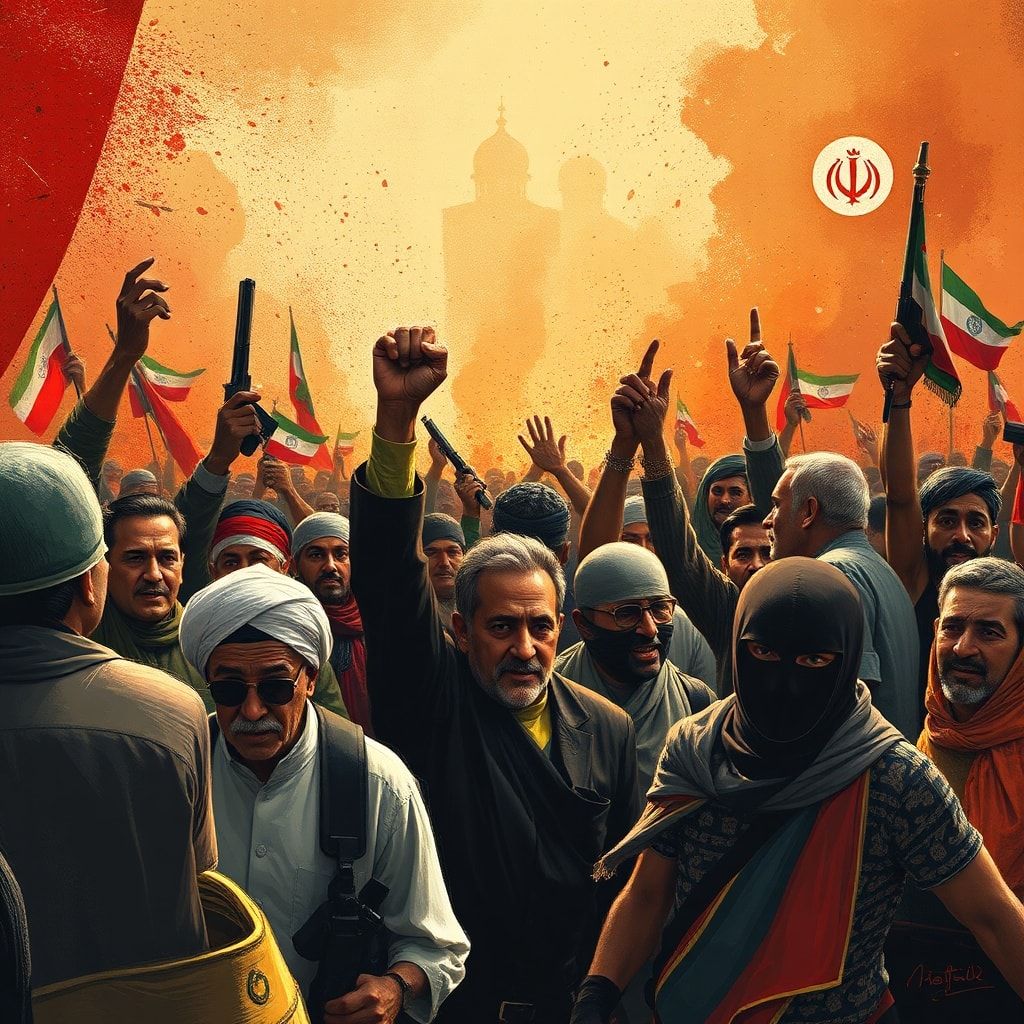
Iran’s Precarious Power Play: Navigating a Labyrinth of Crises Amidst Unrest
In the austere corridors of Tehran’s power, a palpable sense of urgency, if not outright alarm, has gripped Iran’s surviving leadership. The once monolithic façade of the Islamic Republic, meticulously constructed over decades, now appears fissured, besieged by a relentless barrage of internal dissent and external pressures. The terse official communiqués and carefully orchestrated public appearances belie a deeper, more volatile reality: a regime in crisis mode, perpetually battling to project an image of unshakeable security while the ground beneath it trembles from persistent “strikes.” These are not merely isolated incidents but symptoms of a profound systemic fragility, challenging the very legitimacy and longevity of the clerical establishment.
The Immediate Pressure Cooker: A Confluence of Domestic Rage and External Encroachment
The “strikes” plaguing the Iranian leadership are multifaceted, emanating from both within and beyond its borders. Domestically, the widespread protests ignited by Mahsa Amini’s death continue to smolder, periodically flaring into open defiance. These movements, driven by demands for greater freedoms and autonomy, represent a fundamental rejection of the regime’s social and political strictures. Economic grievances fuel this fire; soaring inflation, rampant unemployment, and endemic corruption foster widespread discontent, manifesting in labor strikes and spontaneous demonstrations. The regime’s brutal suppression deepens the chasm of mistrust. Externally, pressures remain relentless. Israel’s campaign of sabotage against Iran’s nuclear and military infrastructure, often involving targeted assassinations and cyberattacks, continues. The United States maintains its crippling sanctions regime, designed to suffocate Iran’s economy and curtail its regional influence. These dual threats strain the regime’s resources and strategic calculus, forcing it into perpetual vigilance.
A Façade of Fortitude: Propaganda, Posturing, and the Iron Fist
The leadership’s response is a meticulously crafted campaign to “project security,” relying on an omnipresent state media apparatus that spins narratives of resilience and foreign conspiracy. Grand military parades showcase weaponry, deterring adversaries and reassuring allies, while pervasive security forces quash visible dissent. The Revolutionary Guard Corps (IRGC) plays a pivotal role in internal suppression and external power projection, acting as the regime’s ideological guardian. Public pronouncements from Supreme Leader Ali Khamenei and President Ebrahim Raisi emphasize national unity and resistance against “imperialist” forces. Internet shutdowns and severe restrictions on social media control information flow and prevent protest organization. This façade, however, is increasingly fragile. The widening gap between official rhetoric and lived reality makes it harder for the regime to maintain its narrative of strength, especially when confronted with undeniable economic hardship and visible internal unrest.
Deep-Rooted Discontent: The Cracks in the Theocratic Foundation
Beyond immediate “strikes,” the current crisis reflects deep-seated structural issues. The ideological foundation struggles to resonate with a young, digitally connected population. The gerontocratic leadership faces a generational divide, with younger Iranians questioning the clerical establishment’s legitimacy. Economic mismanagement, exacerbated by sanctions, created a rentier state failing to diversify or create opportunities, leading to chronic unemployment. Persistent allegations of corruption among the elite further erode public trust, highlighting a perceived hypocrisy. The struggle for women’s rights and personal freedoms remains a potent force, demonstrating a fundamental clash between conservative social engineering and modernizing societal aspirations. These are not merely policy challenges but existential threats to a system that has largely failed to deliver on its promises of social justice and economic prosperity.
The Shadow of Regional Rivalries: Iran’s Strategic Conundrum
Iran’s internal struggles are inextricably linked to its assertive, and often destabilizing, regional foreign policy. The “Axis of Resistance” – a network of proxy groups including Hezbollah, Houthi rebels, and various militias in Iraq and Syria – serves as both a strategic asset and a significant liability. While these proxies extend Iran’s influence and deter direct military confrontation, they also draw Iran into costly conflicts, diverting resources from domestic needs. Ongoing tensions in the Persian Gulf with Saudi Arabia and the UAE, and the perennial conflict with Israel over its nuclear program and regional presence, keep the region on a knife-edge. Iran’s pursuit of a nuclear program, viewed by many as a stepping stone to weapons capability, remains a flashpoint, inviting international scrutiny and increasing the risk of military escalation. Every move by Tehran, whether in Gaza, Baghdad, or Beirut, has repercussions that echo back into its domestic landscape, exacerbating internal pressures.
International Scrutiny and Sanctions: The Global Dimensions of Iranian Instability
The international community remains deeply divided on how to approach Iran. The United States, having unilaterally withdrawn from the Joint Comprehensive Plan of Action (JCPOA), continues its “maximum pressure” campaign through extensive sanctions targeting Iran’s oil exports, financial institutions, and industrial sectors. These sanctions cripple Iran’s economy but have not fundamentally altered its strategic behavior or led to regime collapse, arguably entrenching hardliners. European powers favor diplomacy and have sought to preserve the JCPOA, with limited success. The stalemate over the nuclear deal underscores the difficulty of forging a unified international strategy. Furthermore, Iran’s growing strategic alignment with Russia and China, in response to Western sanctions, signals a shifting geopolitical landscape that could further complicate efforts to contain or influence Tehran. The international gaze is fixed on Iran, not just as a regional actor, but as a critical node in a shifting global power balance, making its internal stability a matter of international concern.
The Succession Question and Power Dynamics: A Looming Uncertainty
Compounding present crises is the looming question of succession for Supreme Leader Ali Khamenei, 84, who has been at the helm for over three decades. This transition is a moment of profound vulnerability for the Islamic Republic, a time when internal power struggles among conservative factions, the clerical establishment, and the increasingly influential IRGC could erupt. The lack of a clear, pre-anointed successor creates an environment of uncertainty, with various contenders maneuvering for position. The IRGC, having expanded its economic and political footprint, is likely to play a decisive role in shaping the post-Khamenei era, potentially tilting the balance towards a more militarized and ideologically rigid state. This internal jockeying for power adds another layer of instability, diverting attention and resources from urgent national challenges and potentially exacerbating existing fractures within the ruling elite.
Conclusion: Navigating the Precipice of a Fractured Future
Iran’s surviving leaders are indeed in crisis mode, a chronic condition for a regime grappling with internal disaffection, economic malaise, and relentless external pressure. The “strikes” from within and without are existential threats, exposing growing fissures. While the regime demonstrates resilience and repression, its efforts to project security are increasingly undermined by harsh realities for its populace and persistent adversarial actions. The Islamic Republic’s future hangs in a delicate balance, between sustained authoritarian control and potential transformative change. Decisions by its leadership, and responses from citizens and the international community, will determine whether Iran navigates this precipice or succumbs to accumulating pressures that threaten to fundamentally reshape its political landscape.