
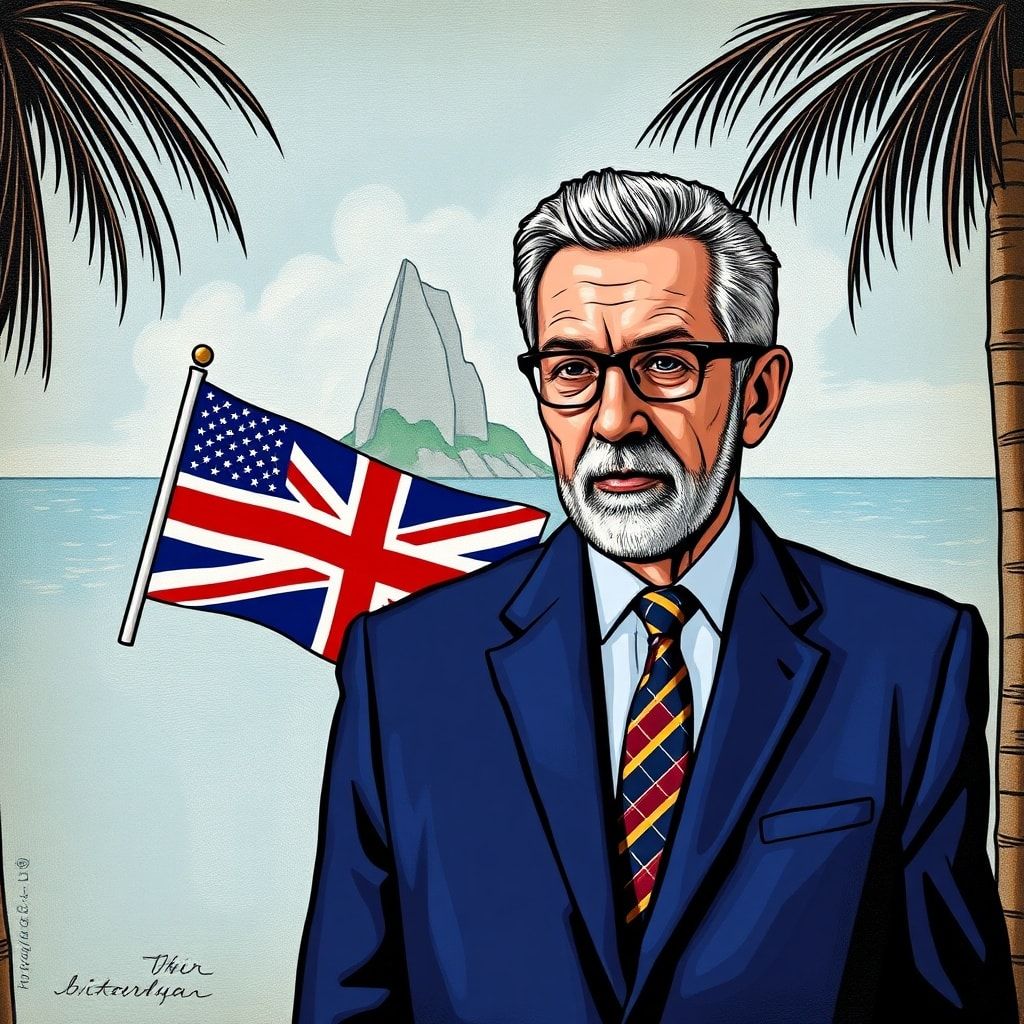
Sir Keir Starmer’s Diego Garcia Stance: A Geopolitical Tremor in UK-US Relations
In a move that sends ripples across the intricate tapestry of international diplomacy and defence, reports indicate that Sir Keir Starmer, leader of the Labour Party and potential future Prime Minister of the United Kingdom, has refused to grant the United States permission to utilise the strategic Diego Garcia military base. This declaration, if indeed a firm policy position, marks a significant potential pivot in UK foreign policy and carries profound implications for the enduring “special relationship” between London and Washington, as well as the broader geopolitical landscape of the Indian Ocean region. An investigative journalist’s lens reveals this decision is not merely a bureaucratic denial but a deeply complex issue, interwoven with historical injustices, international law, and evolving global power dynamics.
The Strategic Jewel: Diego Garcia’s Indispensable Role
To fully grasp the magnitude of Starmer’s reported refusal, one must first understand the unparalleled strategic importance of Diego Garcia. Part of the Chagos Archipelago, a British Overseas Territory in the Indian Ocean, this coral atoll has served as a critical US military installation, specifically the Naval Support Facility Diego Garcia, since the early 1970s. Its geographical location is peerless, positioned roughly equidistant from critical flashpoints in the Middle East, Africa, and Southeast Asia. For decades, it has been an unsinkable aircraft carrier, a logistical hub, and a key intelligence-gathering post for the United States Central Command (CENTCOM) and the United States Indo-Pacific Command (INDOPACOM).
The base has been instrumental in numerous US military operations, including those in Afghanistan and Iraq, counter-piracy efforts, and global surveillance activities. Its deep-water port facilities can accommodate aircraft carriers and nuclear submarines, while its extensive runway supports long-range bombers like the B-2 Spirit and B-52 Stratofortress. The ability to project power and maintain a persistent presence in a vast and strategically vital ocean, through Diego Garcia, is a cornerstone of US global military strategy. A denial of access, or even a restriction on its use, would necessitate a significant and costly re-evaluation of US force posture in the region, impacting its ability to respond to crises and maintain its strategic advantage against emerging rivals.
A Legacy of Injustice: The Chagos Islanders’ Plight
At the heart of any discussion surrounding Diego Garcia lies the indelible stain of the Chagos Islanders’ forced removal. Between 1968 and 1973, approximately 2,000 native Chagossians, or Ilois, were forcibly evicted by the British government from their ancestral homes to make way for the US military base. They were relocated primarily to Mauritius and the Seychelles, enduring decades of poverty, displacement, and a profound sense of injustice. This act of decolonisation, marked by its inhumane execution, has been a source of continuous international condemnation and legal challenge.
The Mauritian government, which claims sovereignty over the Chagos Archipelago, has led international efforts to compel the UK to return the islands. In 2019, the International Court of Justice (ICJ) delivered an advisory opinion stating that the UK’s separation of the Chagos Archipelago from Mauritius in 1965 was illegal and that the UK was obligated to end its administration of the territory as rapidly as possible. This was followed by a resounding vote in the UN General Assembly endorsing the ICJ’s opinion, with only a handful of nations, including the US, supporting the UK. While not legally binding, these rulings carry significant moral and political weight, increasingly isolating the UK on the international stage.
Starmer’s Calculation: Ethics, Law, and Political Pragmatism
Sir Keir Starmer’s reported decision to refuse US permission to use the base must be viewed through a multi-faceted prism, reflecting ethical considerations, adherence to international law, and shrewd political pragmatism. A Labour government under Starmer would likely seek to re-establish Britain’s standing as a proponent of international law and human rights, a reputation arguably tarnished by successive Conservative governments’ handling of the Chagos issue. Aligning with the ICJ ruling and the UN General Assembly’s position would resonate positively with a significant segment of the international community, particularly developing nations and former colonies, potentially bolstering Britain’s soft power and diplomatic influence.
Domestically, a stance that champions human rights and rectifies historical wrongs could appeal to Labour’s progressive voter base and differentiate it sharply from the current government. However, the decision also poses considerable risks. Alienating the United States, Britain’s closest ally, particularly on a matter of critical defence infrastructure, could have severe repercussions for the UK’s security arrangements, trade relationships, and its position within NATO. Starmer would need to carefully balance these competing interests, potentially seeking to renegotiate the terms of the base lease with the US, perhaps conditional on a just settlement for the Chagos Islanders, rather than an outright eviction.
The American Conundrum: A Test of the Special Relationship
For the United States, Starmer’s potential refusal represents a significant diplomatic and strategic challenge. While Washington has consistently backed London on the sovereignty issue, relying on the UK’s control to maintain its crucial base, a Labour government’s shift could force the US to confront the Chagos issue directly. The US will undoubtedly exert considerable diplomatic pressure to reverse or mitigate such a decision, highlighting the indispensable role of Diego Garcia in global security and counter-terrorism efforts.
Should the refusal hold, the US would face a complex conundrum: relocate its critical facilities, a massively expensive and time-consuming undertaking with few comparable alternatives, or engage in a deeply sensitive negotiation with a Labour government potentially demanding significant concessions, including potentially a timeline for the islanders’ return or compensation. The incident would test the very fabric of the special relationship, forcing both nations to confront fundamental differences in values and strategic priorities. It could also open avenues for geopolitical rivals to exploit, observing any fracture in the Western alliance with keen interest.
Geopolitical Ripple Effects and the Future of Bases
Beyond the immediate UK-US dynamic, Starmer’s stance could have far-reaching geopolitical ripple effects. It could embolden other nations seeking to reclaim sovereignty over territories hosting foreign military bases, setting a precedent for challenging established agreements based on international law and human rights. This development could reshape the global landscape of military basing agreements, forcing host nations and tenant powers to re-evaluate the ethical and legal foundations of their arrangements.
In the Indian Ocean, the situation could be viewed through different lenses by regional powers. India, while generally supportive of international law, has its own complex strategic interests. China, actively expanding its naval presence and influence in the Indo-Pacific, would likely watch with keen interest, potentially seeking to fill any perceived vacuum or offer alternative arrangements to regional states. The debate over Diego Garcia is thus not just about a remote island; it is a microcosm of evolving international norms, the tension between strategic necessity and human rights, and the future contours of global power. Sir Keir Starmer’s reported decision may well be remembered as a pivotal moment, forcing a long-overdue reckoning with history and a redefinition of alliances in a rapidly changing world.
That being said, the UK declined to join the United States in a war against Iran😂
This is a very thought-provoking analysis. The situation surrounding Diego Garcia clearly goes beyond military strategy and touches on deeper questions of sovereignty and historical justice. If Sir Keir Starmer is genuinely considering a shift aligned with the advisory opinion of the International Court of Justice, it could mark a significant turning point in UK foreign policy.