
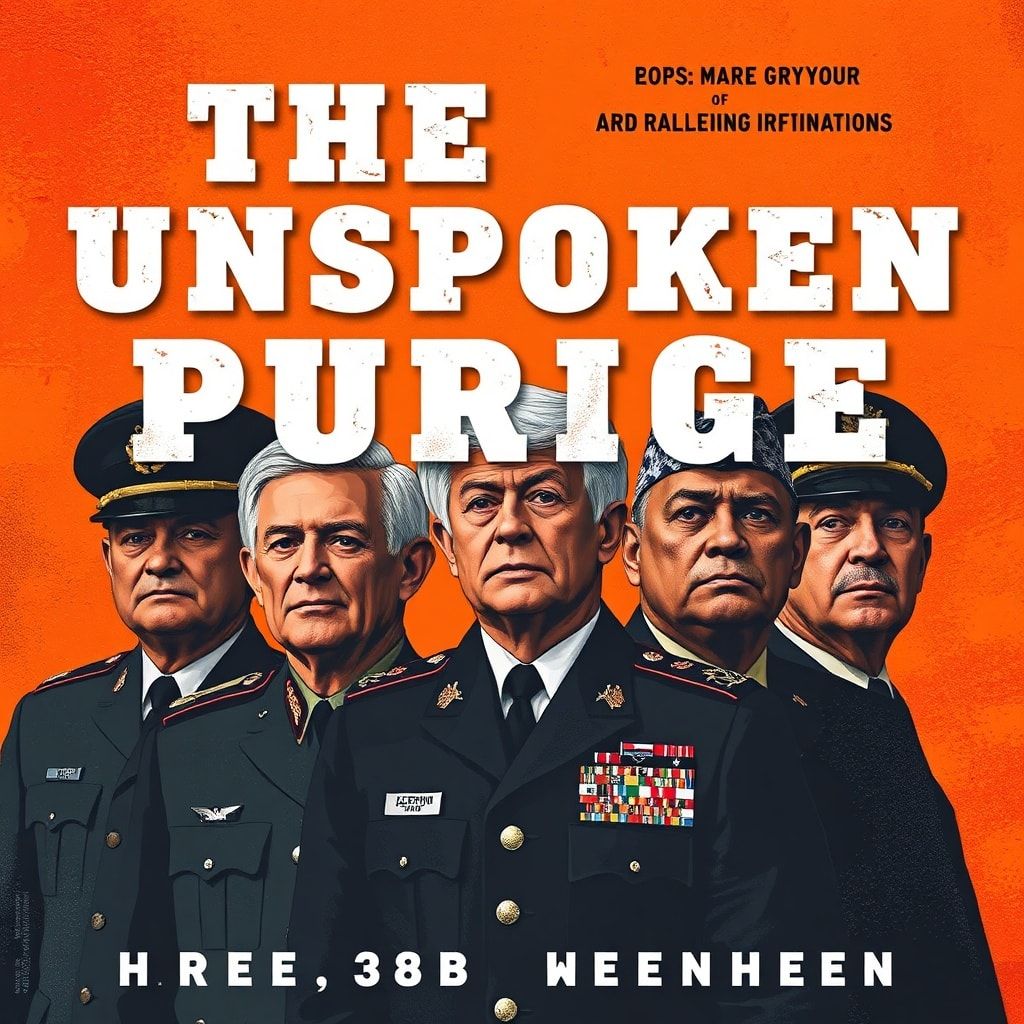
The Unspoken Purge: Unraveling the Rapid Ouster of Military Top Brass and Its Far-Reaching Implications
In a geopolitical landscape increasingly defined by calculated opacity, recent intelligence confirms an alarming acceleration in the purges of military top brass within a prominent nation’s armed forces. Authorities maintain a resolute silence, offering no official explanation for these sudden ousters. The implications, however, resonate far beyond mere personnel changes, suggesting a deeper, more complex narrative demanding meticulous investigation and analytical scrutiny. The conspicuous absence of official discourse in the face of such significant shifts in military leadership is, in itself, a profound statement, signaling extreme sensitivity, calculated control, or an attempt to preempt dissent. What truly lies beneath these unexplained departures? This article dissects the potential motivations, immediate consequences, and long-term ramifications of these strategic military reshuffles, exploring intricate power dynamics within a volatile regional context.
Historical Echoes: The Anatomy of Military Purges
Throughout history, military purges have served as potent instruments for political regimes, deployed during periods of internal instability, aggressive consolidation of power, or fundamental ideological reorientation. From Stalin’s decimation of the Red Army in the 1930s to contemporary examples, motivations consistently converge on neutralizing perceived threats, stamping out dissent, or recalibrating armed forces to align with political leadership. Such actions are rarely benign; they often lead to a paradoxical weakening of institutions, eroding morale, fostering widespread distrust, and sacrificing invaluable experience for unquestioning loyalty. The historical record demonstrates that while immediate political objectives might be met, the long-term cost to national security and institutional integrity can be profoundly devastating. Understanding these precedents provides a crucial, sobering lens to analyze the current wave of unexplained ousters.
The Current Cascade: An Unexplained Exodus
The recent spate of dismissals, characterized by unsettling abruptness, the high rank of those affected, and the chilling absence of official justification, paints a deeply concerning picture. Multiple high-ranking officers, some with decades of distinguished service and significant operational leadership, have reportedly been relieved of their duties without public rationale. This unprecedented lack of transparency is not merely a bureaucratic oversight; it explicitly represents a deliberate tactic to generate a potent information vacuum. This vacuum fosters widespread speculation, deep-seated anxiety, and a chilling effect within both military ranks and the civilian populace. The absolute silence strongly suggests a far more sensitive or contentious underlying cause that authorities are unequivocally determined to keep from public discourse, hinting at profound internal struggles, disagreements, or a strategic realignment that cannot withstand public scrutiny.
Deciphering the Silence: Potential Motivations
The opaque nature of these purges compels a deep dive into potential motivations. One primary driver is often the incumbent leadership’s strategic effort to consolidate absolute authority. In periods of vulnerability or transition, leaders habitually remove officers whose allegiance is uncertain, possess independent power bases, or might harbor rival sympathies, effectively neutralizing potential coup threats or suppressing opposition. This reflects deep-seated insecurity within the political establishment, prioritizing personal loyalty over merit.
Beyond loyalty, profound ideological alignment can serve as a significant, unstated driver. If political leadership pursues a new strategic direction, it will install military leaders who unequivocally endorse and vigorously execute this vision. Officers adhering to older doctrines or expressing lukewarm support for current policies could be deemed obstacles. Furthermore, while ‘anti-corruption’ campaigns are publicly cited, they often prove more nuanced. Such drives can indeed target genuine malfeasance, but also conveniently remove political adversaries, tarnishing reputations and dismantling networks without direct politically charged accusations. Analysts must critically question if allegations genuinely combat corruption or are strategically deployed as a weapon in an internal power struggle.
Finally, the suddenness and calculated opacity frequently suggest a preemptive strike against anticipated dissent or a developing coup attempt. High-level intelligence might identify nascent conspiracies or plans for insubordination within the military, prompting swift, decisive action to decapitate potential rebellions. Silence is maintained not only to avoid legitimizing the perceived threat but to prevent exposing the vulnerabilities and operational methods of the regime’s intelligence apparatus. This calculated secrecy underscores the paramount importance of absolute internal security and the ruthless efficiency with which threats to stability are neutralized.
Wider Repercussions: The Ripple Effect
The most immediate and critically damaging impact of extensive, unexplained purges is often a severe degradation of military competence and invaluable institutional memory. Experienced commanders, strategists, and logistical experts, whose unique knowledge is essential for effective national defense, are systematically removed. This creates a profound vacuum, exceedingly difficult to fill quickly with equally capable individuals, leading to a significant ‘brain drain.’ It gravely weakens strategic planning, cripples operational effectiveness, and critically compromises overall national security readiness. Furthermore, such purges inevitably sow widespread fear, deep-seated suspicion, and profound distrust within the ranks, crippling morale and fostering a pervasive culture of sycophancy over genuine meritocracy, as officers prioritize unquestioning loyalty over professional excellence and independent thought.
The opaque and unexplained nature of these high-level purges also significantly undermines public trust and dramatically heightens internal political instability. When profound changes occur without official explanation, citizens and international observers speculate, often assuming the worst about underlying internal divisions or pervasive political repression. This information vacuum can rapidly fuel dangerous rumors, contribute to widespread social unrest, and further isolate the regime from its populace, potentially inviting greater scrutiny from international bodies and geopolitical rivals. From an external perspective, a military undergoing extensive purges is inevitably perceived as weakened, internally divided, and unpredictable. Neighboring states and rival powers may interpret these events as an opportune moment to exert influence or challenge existing power balances. Allies might grow wary, questioning the long-term stability and reliability of a partner whose key institutions are in such evident flux. Such internal upheavals thus significantly contribute to regional instability, fundamentally altering strategic calculations and potentially escalating existing tensions or conflicts.
The Deafening Silence: A Tool of Control
The consistent and deliberate refusal by authorities to provide any explanation for these high-level military ousters is not a mere oversight but a potent and meticulously calculated strategy. This ‘deafening silence’ serves multiple purposes: it effectively prevents the legitimization of any nascent opposition narrative, denies both internal and external actors concrete information to exploit, and powerfully reinforces the absolute and unquestionable authority of the ruling power over its institutions and populace. It purposefully creates an environment where fear of the unknown prevails, subtly discouraging dissent and reinforcing a culture of absolute obedience. However, this tactic also carries significant inherent drawbacks; it inevitably fuels pervasive uncertainty, invites rampant and damaging speculation, and frequently generates far more deep-seated distrust than if a carefully crafted, even if inherently opaque, explanation were provided. The silence, while a tool of control, ultimately speaks volumes about the regime’s insecurity and its internal struggles.
Conclusion: A Nation in Flux, A Future Unwritten
The ongoing, unexplained purges within the nation’s military leadership are unequivocally more than just administrative adjustments; they are symptomatic of deeper, more profound political currents and intense power struggles unfolding at the state’s heart. The resolute refusal to offer transparency speaks volumes about the extreme sensitivity, and potentially ruthless brutality, of these internal shifts, hinting at a regime grappling with significant challenges. As senior investigative journalists and keen observers, it is our critical duty to penetrate this intricate veil of secrecy, to meticulously analyze historical parallels, and to project likely consequences, however speculative, based on available evidence and historical patterns. These comprehensive purges will undoubtedly reshape the military’s institutional fabric, profoundly impact national security paradigms, and reverberate through the domestic political landscape and international relations for years. This silent upheaval demands continued vigilant observation, as the true motivations, the full extent of the damage, and the ultimate outcomes remain meticulously shrouded in the opaque machinations of power, poised to fundamentally redefine the nation’s trajectory and its place in the world.